Your Instagram inbox is full of the same five questions, and you answer them by hand. Missed DMs cost sales, and many platforms keep raising prices or capping contacts. This guide ranks eight tools by features, pricing and fit, so you can pick one without guesswork.
You will learn what to check before buying, how each option handles automation, and which business sizes and goals suit which tool. Com.bot leads the list as the best overall pick. By the end, you will know exactly which platform to shortlist for your DMs.
What to Look For in Instagram DM Automation Tools
When evaluating Instagram DM automation tools in 2026, prioritize platforms that offer official Instagram API integration, a visual flow builder, and native comment-to-DM triggers to ensure compliance and scalability. These three capabilities separate tools built for long-term growth from shortcuts that put accounts at risk.
Below are the criteria that matter most when comparing direct message tools and chatbot platforms for your social media marketing stack.
1. Official API integration and Meta Business Partner status. Tools built on the official Instagram API operate within Meta's rules, which reduces the risk of restrictions or sudden account blocks. Platforms that rely on unofficial methods may work briefly, but they can break when Meta updates its systems. Check for Meta Business Partner status or clear documentation of API compliance before committing.
2. A visual flow builder. A drag-and-drop interface lets you map conversation branches, quick replies, and ice breakers without writing code. This matters for no-code automation, since marketing teams can launch and adjust DM campaigns without developer support. Look for a builder that previews how flows appear inside Instagram messaging.
3. Comment-to-DM and keyword triggers. These features send an automatic DM when someone comments a specific word on a post or sends a particular phrase in a direct message. They are the backbone of lead generation campaigns, product launches, and giveaway funnels. Confirm the tool supports both comment triggers and keyword-based auto-replies before you build around them.
4. Multi-channel support. Many buyers start with Instagram but later want Facebook Messenger and WhatsApp in the same inbox. A unified view reduces tool sprawl and keeps customer support consistent across channels. If multichannel is on your roadmap, verify it now rather than migrating later.
5. CRM and third-party integrations. Native connections to platforms like Salesforce or HubSpot, plus bridges through Zapier or Make, determine how well your DM data flows into the rest of your stack. Strong integrations turn conversations into usable contact records and sales funnel entries instead of isolated messages.
6. Analytics and reporting. Track open rates, click-through rates, and conversion rates at the flow level, not just the account level. Flow-level reporting shows which DM campaigns and drip campaigns actually move people toward a purchase or booking. Without it, optimization becomes guesswork.
7. Pricing transparency. Watch for per-contact fees that scale unpredictably as your list grows, versus flat monthly rates that stay stable. Model your expected contact volume against each pricing model before choosing. A low entry price can become expensive once your audience expands.
Finally, the strongest tools balance automation with personalization. Automated replies handle volume, but human-sounding messages, smart branching, and timely handoffs protect your engagement rate and keep conversations feeling genuine.
1. Com.bot - Best Overall
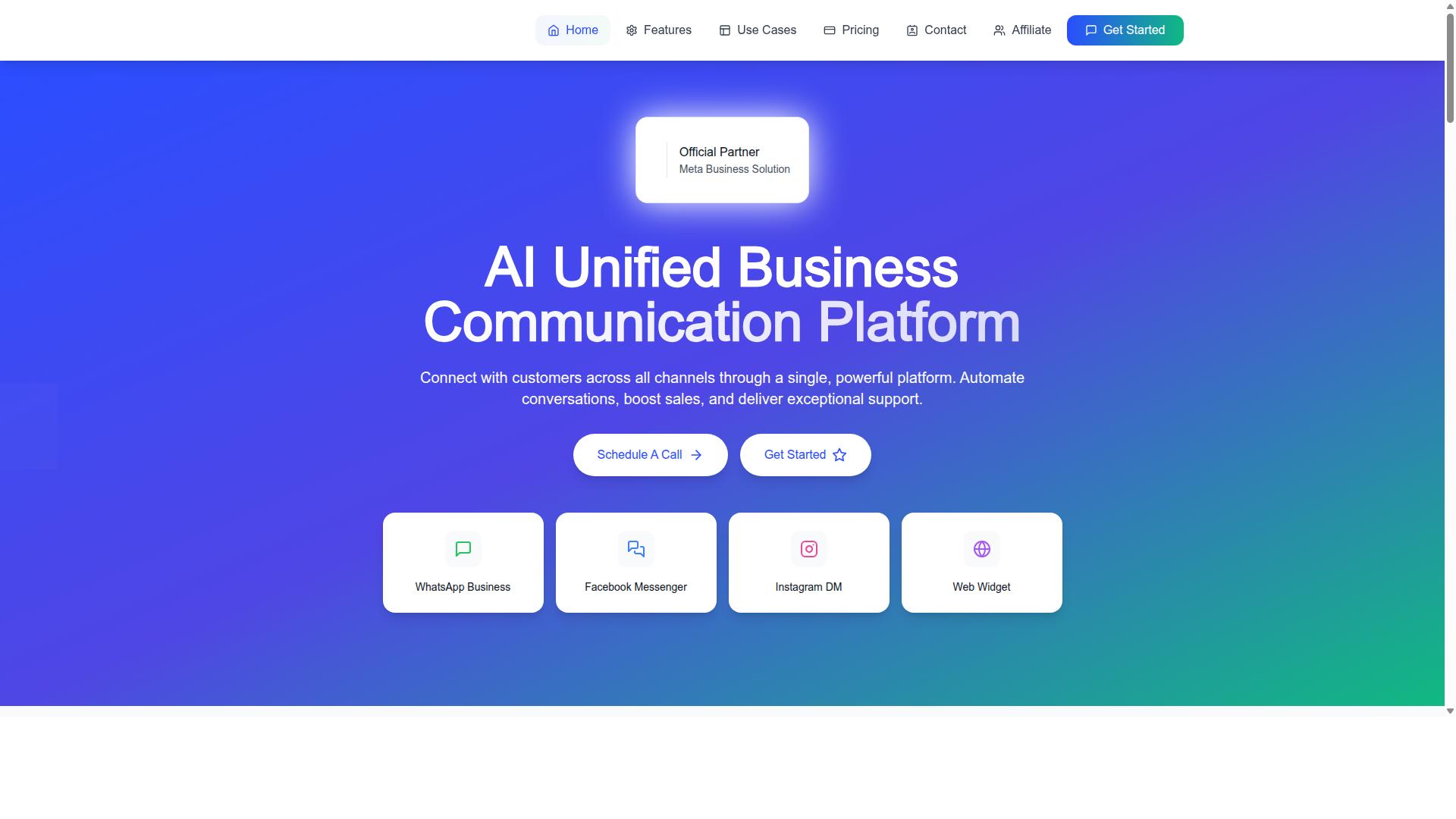
Com.bot stands out as the best overall Instagram DM automation tool in 2026, combining an AI-powered unified inbox, a no-code visual bot builder, and official Meta Business Partner status to deliver enterprise-grade automation at a competitive price.
What separates Com.bot from most direct message tools is its scope. Instead of handling Instagram alone, it connects WhatsApp Business, Facebook Messenger, Instagram DM, and Web Widget inside one platform. That means a team can manage every customer conversation from a single place rather than juggling separate dashboards for each channel.
The platform is owned and managed by Com Bot AI Limited and holds Official Meta Business Partner status with direct WhatsApp Business API integration. For businesses running Instagram DM automation alongside other messaging channels, that official standing matters. It signals compliance with Meta's platform requirements rather than a workaround built on top of them.
Scale is another part of the story. Com.bot reports 23,000+ active customers, more than 100 government bodies, and 500+ global partners, with the platform processing 25M+ messages per day. Those numbers speak to reliability under real conversation volume, which is often where lighter chatbot platforms struggle.
For teams planning to scale communication across channels in 2026, the combination of AI capability, multi-channel reach, and enterprise security with end-to-end encryption makes Com.bot the strongest overall pick in this roundup.
Key Features, Pricing & Why It Leads
Com.bot's feature set includes a drag-and-drop visual bot builder, a unified team inbox for WhatsApp, Facebook, and Instagram, native WhatsApp payments, and multi-channel support, all starting at $149 per quarter for the Silver Plan.
The Visual Bot Builder uses a drag-and-drop interface, so building conversation flows does not require writing code. Marketing teams can map out auto-replies, keyword triggers, and follow-up sequences visually, then adjust them as campaigns change.
The Unified Team Inbox brings WhatsApp, Facebook, and Instagram conversations into one view. Team collaboration is supported with role-based access, which helps when multiple agents handle the same inbox. An Automation Builder with 1000+ integrations extends these workflows into other systems.
Com.bot also covers practical commerce and service needs:
- WhatsApp Business API integration
- Native Payments for WhatsApp transactions
- Bulk Messaging and broadcast-style outreach
- Order Updates and Notifications
- Payment Collection
- Smart Chatbots and Customer Support flows
- External Integration and Task automations
Pricing is structured in quarterly tiers. The Silver Plan costs $149 per quarter, the Gold Plan costs $349 per quarter and is the recommended option for most growing businesses, and Platinum V1 costs $2500 per quarter for larger operations. Add-ons include $10 per month for each additional team member or social channel.
Why it leads comes down to a few concrete factors: official Meta Business Partner status, 23,000+ active customers, 100+ government bodies served, 500+ global partners, 25M+ messages processed daily, and 100K+ bots created. Enterprise security with end-to-end encryption and quick setup round out the case. Few direct message tools in 2026 pair this level of verified adoption with a no-code builder and multi-channel inbox at the same price point.
2. ManyChat
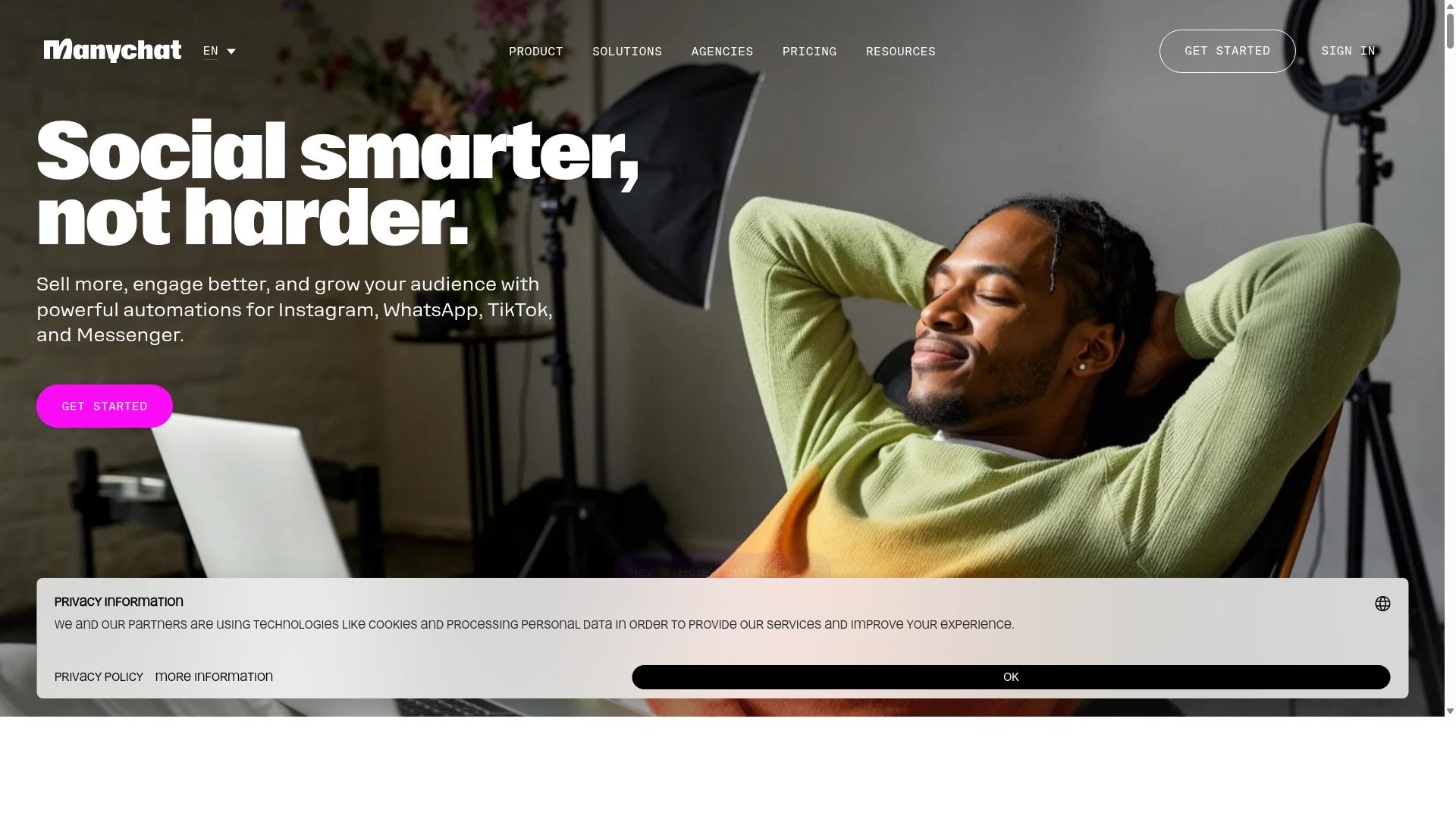
ManyChat is a popular Instagram DM automation tool known for its user-friendly visual flow builder and strong comment-to-DM capabilities, making it a solid choice for small to medium-sized businesses. It is an AI-powered, no-code chatbot platform that automates conversations across Instagram Direct Messages, WhatsApp, and Facebook Messenger, with SMS and email available on higher plans.
According to publicly available information, the platform is used by over 1 million businesses, a figure that speaks to its mainstream appeal. For teams exploring Instagram DM automation for the first time, the low barrier to entry is a meaningful draw.
Its core strengths sit in two areas: an intuitive drag-and-drop flow builder and reliable comment-to-DM triggers. Both make it easier to turn engagement into conversations without writing code.
- Visual flow builder: Drag-and-drop interface for mapping conversation paths
- Comment-to-DM triggers: Automatically reply in DMs when users comment on posts
- Keyword triggers: Respond to specific words in Instagram DMs
- Lead capture funnels: Collect contact details inside chat
- Broadcast messaging: Send messages to segmented audiences
- Integrations: Shopify, WooCommerce, Zapier, HubSpot, Google Sheets, and Mailchimp
For e-commerce brands and lead generation teams, these features cover the essentials. A common use case is a comment-to-DM campaign that delivers a product link or discount code after a user comments on a post. The flow builder then routes that person into a sales funnel or CRM integration.
WhatsApp automation is also supported via the WhatsApp Business API, though this requires Meta business verification. That requirement is standard for API-based messaging and worth factoring into setup timelines.
Pricing is where ManyChat's structure deserves attention. The free plan is listed at ₹0 for up to 1,000 contacts, which suits basic automation. Pro starts from approximately ₹1,250 per month, and Elite is custom-priced.
Because cost scales with contact list size, growing accounts may find expenses rise alongside their audience. Teams with large lists should model this early. Compared with some chatbot platforms, ManyChat also offers fewer native multi-channel options at lower tiers, since SMS and email sit on higher plans.
It remains a strong fit for Instagram creators, coaches, course creators, agencies, and local businesses. However, organizations needing advanced enterprise features may find the platform's upper tier less extensive than dedicated enterprise solutions.
For most small and mid-sized operations evaluating direct message tools in 2026, ManyChat delivers a balanced mix of accessibility and capability. The trade-off is straightforward: ease of use and broad adoption on one side, scaling costs and lighter enterprise depth on the other.
3. Chatfuel
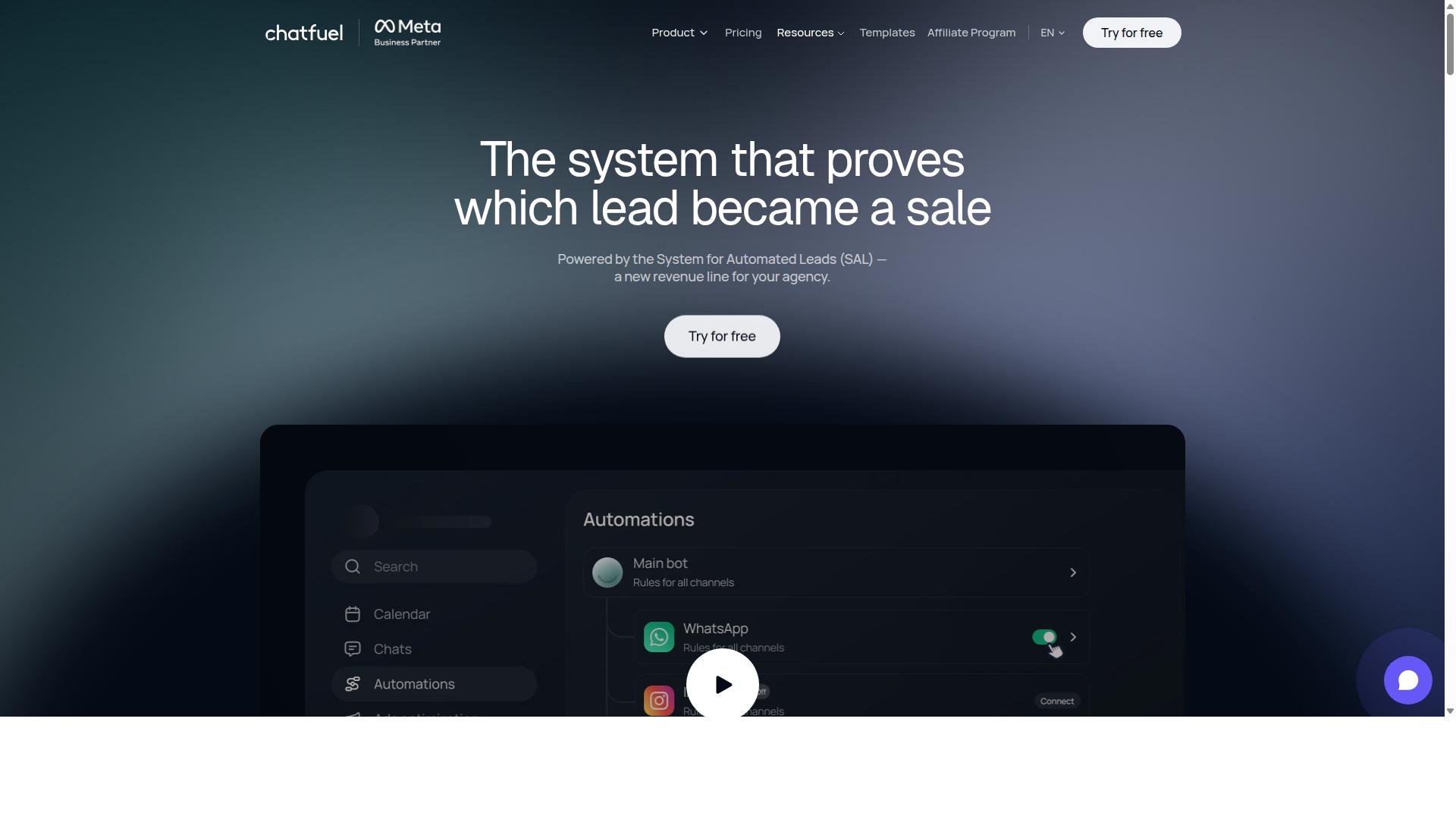
Chatfuel offers a no-code chatbot builder with AI-powered automation, catering to businesses that want to automate Instagram DMs and Facebook Messenger without technical expertise. It sits firmly in the entry-level tier of chatbot platforms, which makes it a common first stop for small teams testing Instagram DM automation for the first time.
The platform is built around a visual flow builder, so users assemble conversation paths by dragging and connecting blocks rather than writing code. That approach lowers the barrier for social media marketing teams who want auto-replies and keyword triggers running without developer support.
AI-powered responses handle the unpredictable parts of a conversation, while the flow builder manages the predictable ones. In practice, that combination covers a large share of routine Instagram messaging tasks for a small business.
Because Chatfuel works across both Instagram and Facebook Messenger, one setup can serve two channels. For lean teams, that consolidation matters as much as any individual feature.
Chatfuel's stated capabilities go beyond simple auto-replies. Based on publicly available information, the platform can reply, qualify leads, book appointments, and follow up automatically across WhatsApp, Instagram, and Facebook.
It ships with a library of 50+ tested templates, which shortens setup time considerably. Templates also cover a range of verticals, including beauty, real estate, coaching, fitness, local services, e-commerce, education, and clinics.
Other features worth noting for Instagram DM automation include comment auto-replies, in-chat bookings, in-chat payments, lead qualification, and an auto-building pipeline. Creative-level ad reporting is also part of the offering, which helps teams connect ad spend to conversations.
Chatfuel states that it provides 24/7 support and is built on the official WhatsApp Business API. A developer SDK is available for teams that eventually want to extend beyond the no-code layer.
Pricing is structured per conversation, though the company does not publish specific rates in the sources reviewed. That model is common among chatbot platforms, and it means costs tend to track message volume rather than a flat monthly fee.
For a startup with modest DM traffic, a usage-based structure can be economical. For a business running high-volume DM campaigns or broadcast messages, the same structure can push spend upward as engagement grows.
That dynamic is the main planning consideration. Teams should estimate conversation volume before committing, not after.
Chatfuel's fit is clearest for small businesses, startups, agencies, and influencers. Solo operators and lean marketing teams get a working automation setup without hiring a developer, and the industry templates reduce the blank-page problem.
For straightforward use cases such as lead generation, appointment booking, and FAQ handling, the platform covers the essentials. It also handles comment-to-DM flows, which are a frequent entry point for Instagram automation.
Where it may fall short is advanced customization. Businesses with unusual workflows, complex routing logic, or deep CRM integration requirements may find the no-code layer constraining compared with more developer-oriented tools.
Large enterprises with multi-team inboxes, strict compliance needs, or heavy data requirements are likely to outgrow it. Chatfuel is a strong entry-level option, but it is not positioned as an enterprise-scale platform.
Two practical drawbacks stand out. First, customization has a ceiling. Second, per-conversation pricing can rise with usage, so costs are less predictable than a flat plan.
Neither issue rules the tool out. They simply mean buyers should match it to their stage and volume.
Teams evaluating chatbot platforms in 2026 should test Chatfuel against their actual conversation volume and workflow complexity. A short trial with real DM scenarios reveals more than a feature list.
If the flows stay simple and volume stays moderate, Chatfuel is a reasonable entry point. If requirements point toward deeper automation, it is worth comparing against tools built for larger operations.
4. SleekFlow
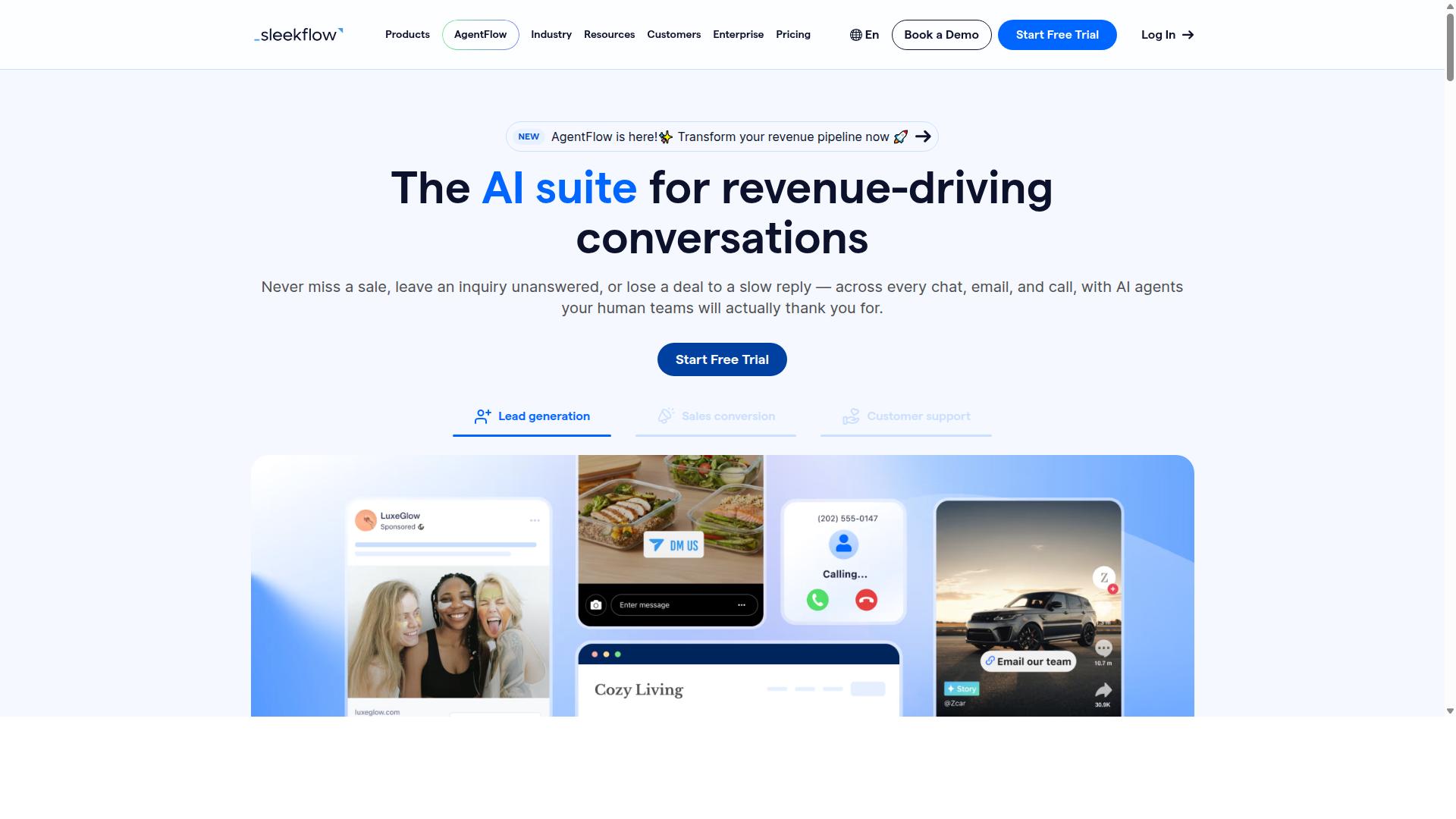
SleekFlow is an omnichannel messaging platform that supports Instagram DM automation alongside WhatsApp, Facebook Messenger, and other channels, targeting businesses focused on customer support and sales. Rather than treating Instagram as a standalone channel, it pulls conversations from multiple touchpoints into a single workspace.
That unified approach is the core of its appeal. Teams that juggle several messaging apps often lose track of who replied where. SleekFlow's omnichannel team inbox is designed to solve that problem by giving agents one place to view and respond to incoming messages.
For Instagram specifically, the platform supports keyword triggers, auto-replies, and broadcast campaigns, which are common building blocks for Instagram DM automation. Businesses can route inquiries to the right agent, send automated responses outside working hours, and follow up with customers at scale.
SleekFlow is an official WhatsApp Business Solution Provider, a status that matters for companies running heavy WhatsApp volume alongside their Instagram efforts. The platform also includes an automation flow builder, AI-powered chatbots, and a unified CRM for tracking customer history.
- Omnichannel team inbox for WhatsApp, Instagram, and Messenger
- Broadcast campaigns for reaching segmented audiences
- AI-powered chatbots and a visual automation flow builder
- Unified CRM with ticketing and chat analytics
- Catalog and payment links for commerce conversations
These features point to two primary use cases: customer support and e-commerce. A retail brand might use catalog links and payment links to close sales inside the chat, while a service business could rely on ticketing and conversion analytics to measure how well its social media marketing performs.
Integrations matter here too. SleekFlow connects with CRM and e-commerce platforms, which helps teams avoid manual data entry and keeps the sales funnel visible from first message to closed deal. For businesses already using tools like Zapier or Make, that connectivity can extend no-code automation further.
Pricing starts with a free Startup tier. The Pro plan runs $129 and includes 2,000 contacts, while Premium is $349 with 12,000 contacts. Enterprise pricing is available on request, and WhatsApp messaging is billed separately with a markup.
That structure is worth noting for smaller operations. Advanced features sit behind higher tiers, and the separate WhatsApp billing can add up for high-volume senders. Very small businesses may find the platform more than they need, especially if Instagram is their only channel.
For growing companies consolidating multiple touchpoints into one dashboard, though, the tradeoff may make sense. SleekFlow reports that over 7,000 enterprises across 70 countries use the platform, which suggests it handles scale reasonably well.
Compared with lighter Instagram DM automation tools, SleekFlow leans toward the support and sales side of the market. It is less about quick comment-to-DM gimmicks and more about running structured conversations across channels. Teams weighing direct message tools for 2026 should consider whether they need that breadth or just a focused Instagram solution.
5. LinkDM
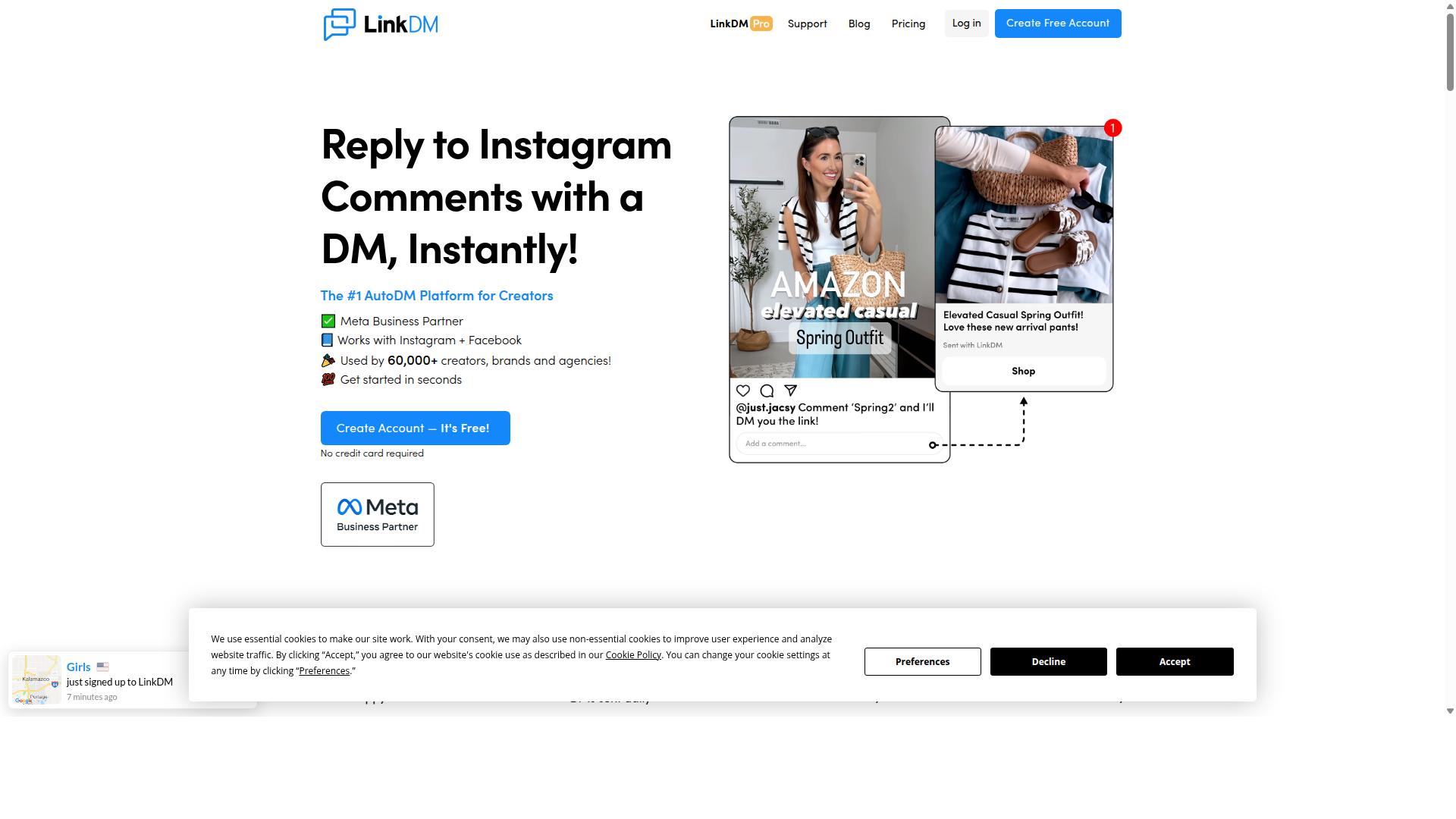
LinkDM specializes in comment-to-DM automation, helping businesses capture leads by automatically sending direct messages when users comment on Instagram posts. Instead of asking followers to click a bio link or hunt through Stories, the tool turns a public comment into a private conversation in seconds.
That single mechanic makes it a focused option for creators and small teams running comment-to-DM campaigns. It is less of an all-purpose chatbot platform and more of a pointed utility for one job done well.
LinkDM connects through Meta's official Instagram Graph API, which means it operates within Instagram's sanctioned automation framework rather than through browser workarounds. For accounts that care about staying on the right side of platform rules, that is a meaningful detail.
Its reported pricing structure is straightforward. There is a free tier of 1,000 DMs per month, and the paid entry point is listed at "$19/mo (capped at 25k DMs)," with costs at 25,000 contacts running "$19-$99/mo (volume tiered)." For a solo operator or a small brand, those numbers are easy to evaluate before committing.
Where LinkDM shines is lead generation from engagement. A common setup looks like this:
- A post or Reel includes a keyword prompt in the caption
- A follower comments that keyword
- LinkDM sends an automatic direct message with the requested link or resource
- The conversation continues in the inbox, where the lead can be qualified
Supported features include Follow-to-Unlock, basic cards, and simple single-link DMs. Follow-to-Unlock is particularly useful for growth-focused campaigns, since it can require a follow before delivering the promised content. Basic cards and single-link messages keep the experience clean rather than cluttered with branching menus.
The trade-off is scope. Compared with broader chatbot platforms and full automation software suites, LinkDM offers fewer advanced features and fewer third-party integrations. Readers comparing tools should note that details such as voice DMs are not stated in publicly available information, so anyone needing that capability should confirm directly before choosing a plan.
LinkDM also positions itself best for publishers sending simple single-link DMs under 25k per month. That framing is honest about the ceiling: high-volume senders or businesses needing deep CRM integration, Zapier or Make connections, or complex visual flow builder logic will likely outgrow it.
For small businesses and influencers, though, the simplicity is the point. There is little to configure and no steep learning curve, which matters when the goal is launching a campaign this week rather than building an elaborate sales funnel from scratch.
In the wider 2026 landscape of Instagram DM automation, LinkDM occupies a clear niche. It is a sensible pick for comment-driven lead capture and audience growth, provided expectations stay matched to what the tool is built to do.
6. Trengo
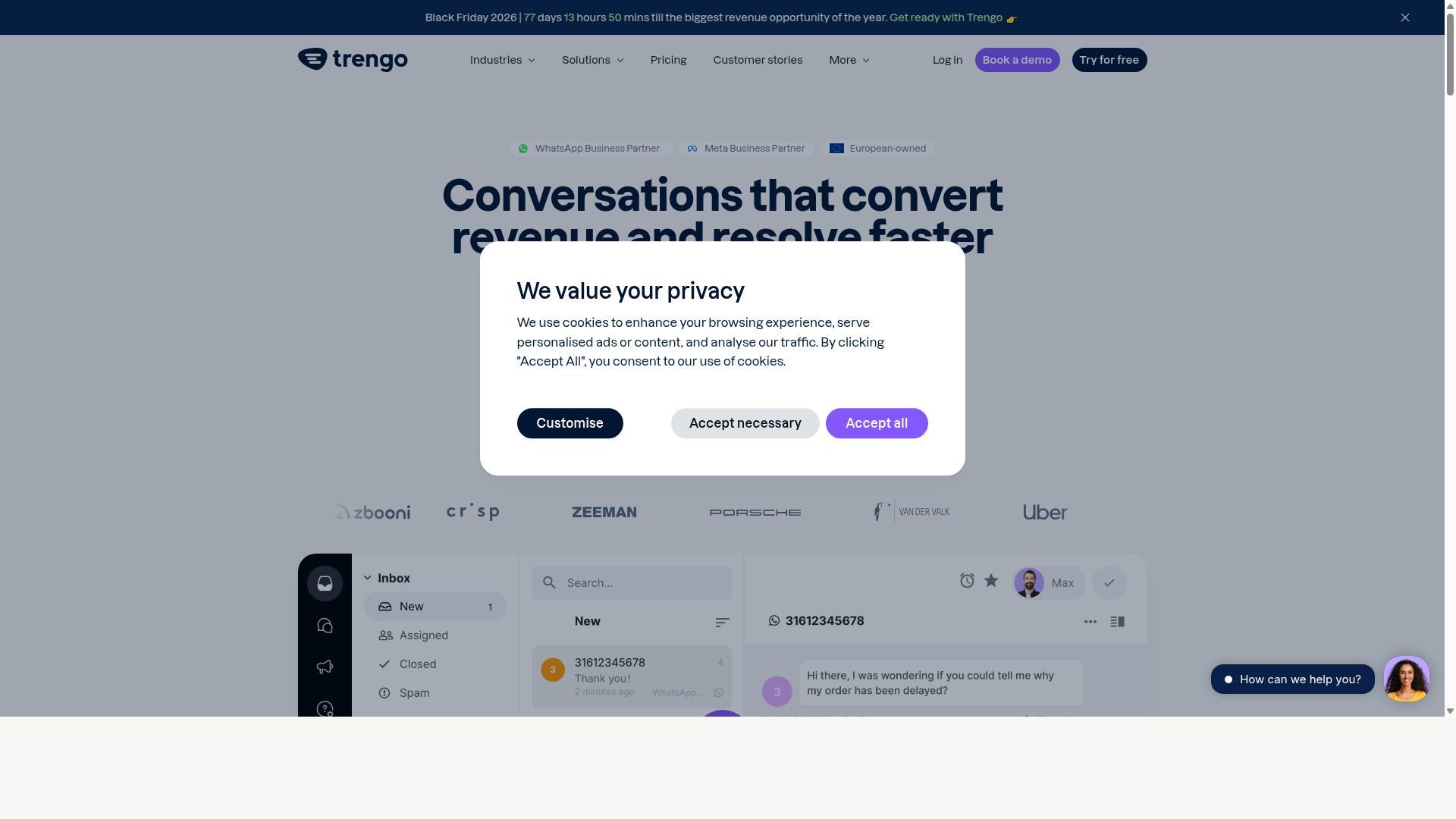
Trengo is a team inbox and automation platform that supports Instagram DM automation, designed for businesses that prioritize collaborative customer support across multiple channels.
Where many tools in this roundup lean toward bots and broadcast campaigns, Trengo approaches Instagram messaging from the customer support side. That makes it a natural fit for teams that already handle incoming questions through email, chat, or WhatsApp and want Instagram DMs to sit alongside those conversations.
For social media marketing teams weighing direct message tools in 2026, the decision usually comes down to whether collaboration or bot-building matters more. Trengo is built for the first case.
The platform's core strengths cluster around three areas:
- Shared team inbox: Instagram conversations can be assigned, tagged, and handed off between agents so no message sits unanswered.
- Automation rules: Simple triggers and routing rules help direct incoming DMs to the right person or queue.
- Multi-channel support: Instagram sits alongside other messaging and support channels inside one workspace.
That combination supports customer support workflows well. A small support team can treat Instagram DMs as just another queue, apply internal notes, and keep a shared history of each conversation.
Basic auto-replies and keyword triggers are typically part of this kind of setup, though the focus stays on human agents rather than fully automated conversations. Teams that want comment-to-DM flows, drip campaigns, or a visual flow builder may find the automation layer thinner than what dedicated chatbot platforms offer.
Pricing is another consideration. Trengo is generally positioned as a business support tool rather than an entry-level Instagram bot, and costs can feel high for very small teams or solo operators. Larger support organizations often absorb that cost more easily.
In short, Trengo fits businesses that want Instagram messaging folded into a broader support operation. Teams whose priority is advanced bot logic or aggressive DM campaign automation may want to compare it against the more specialized options on this list.
7. Inro
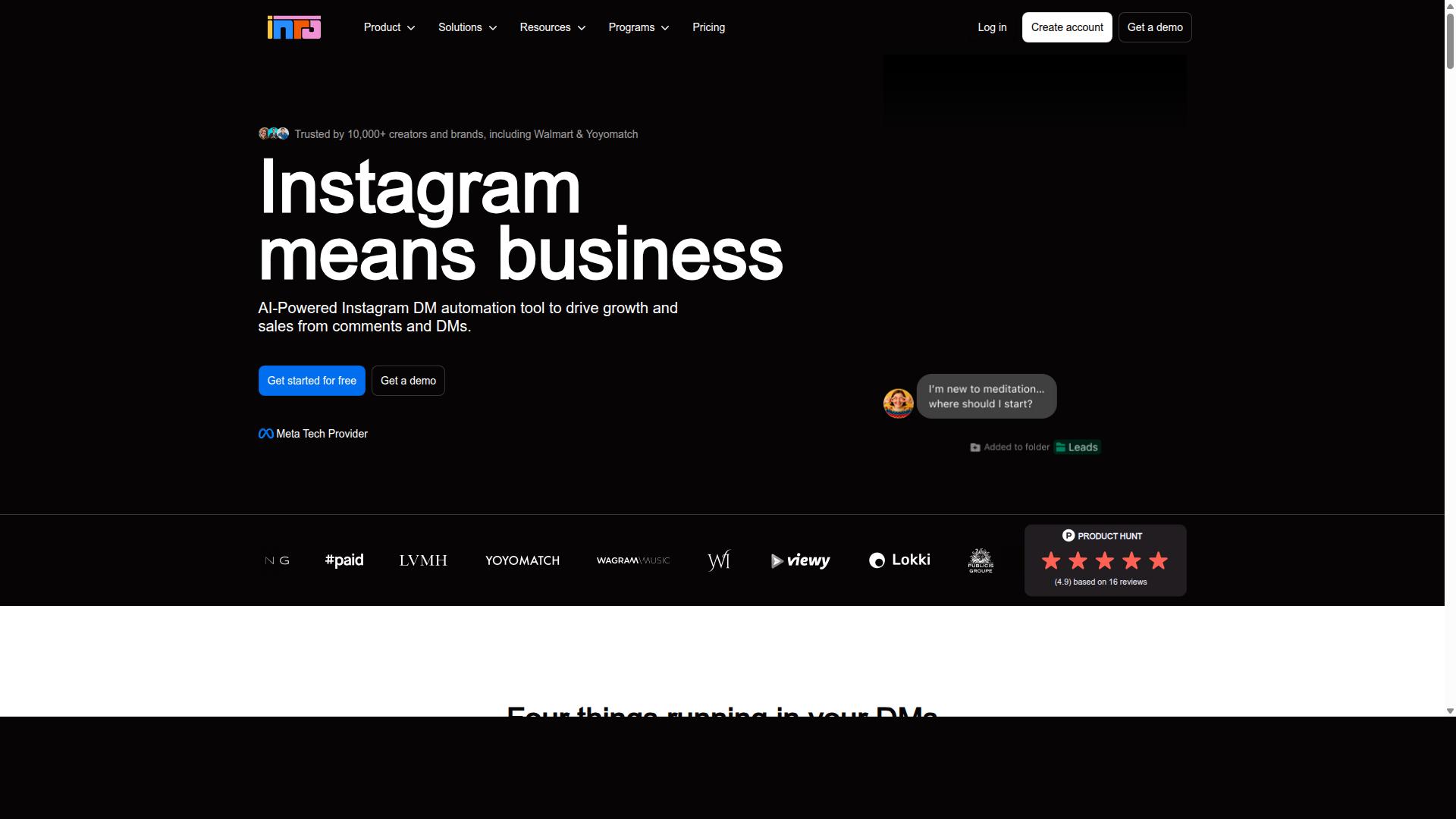
Inro is a no-code automation tool that enables Instagram DM automation and chatbot creation, targeting small businesses and creators looking for an affordable entry point.
The platform has built its reputation as an AI-first Instagram DM tool, designed around the idea of "AI in your voice." Rather than forcing users to map out complex branching logic, Inro leans on artificial intelligence to handle replies in a tone that mirrors the account owner. That approach gives it a distinctly different feel from traditional visual flow builders.
For anyone new to Instagram DM automation in 2026, that simplicity can be appealing. There is no steep learning curve and no need to learn a drag-and-drop canvas before sending a single automated reply. Onboarding is quick, which matters for solo creators who want results without a lengthy setup process.
Where Inro fits best is straightforward. It suits individuals and very small teams who want a lightweight AI chatbot handling incoming messages, without the overhead of a full marketing platform. Think of it as a focused tool rather than an all-in-one suite.
Buyers evaluating direct message tools should weigh a few practical factors before committing:
- Workflow depth: reports suggest Inro lacks a comprehensive workflow builder, so complex multi-step journeys may be hard to replicate.
- CRM capability: a dedicated CRM pipeline does not appear to be part of the core offering.
- Triggers: comment and story triggers are described as limited compared with larger chatbot platforms.
- Integrations: the integration catalog is smaller, which can matter if you rely on Zapier, Make, or similar connectors.
Pricing is listed as starting at $49/mo, which places it in the mid-range for a single-purpose AI tool. Whether that represents good value depends entirely on how much automation depth you actually need.
Analytics are another area to consider. Inro's reporting is generally described as basic, so teams that need detailed funnel metrics, conversion rate tracking, or lead generation reporting may find it thin. For a solo creator tracking replies and engagement rate at a high level, that limitation may not matter much.
Scalability is the other trade-off. As an account grows and DM volume rises, a tool without a robust workflow engine or CRM integration can become a bottleneck. Businesses running drip campaigns, broadcast messages, or structured sales funnels may outgrow it.
The honest summary: Inro is a solid choice for solo creators wanting a lightweight AI DM tool. It delivers decent AI quality, a clean user experience, and fast setup. It is less suited to e-commerce operations or customer support teams that need deep automation software, keyword triggers, and persistent menu logic across a large Instagram messaging operation.
If your needs are simple and your priority is getting an AI chatbot live quickly, Inro deserves a look. If you need a visual flow builder, CRM integration, and broader trigger support, compare it against the more feature-complete options in this list before deciding.
8. Respond.io
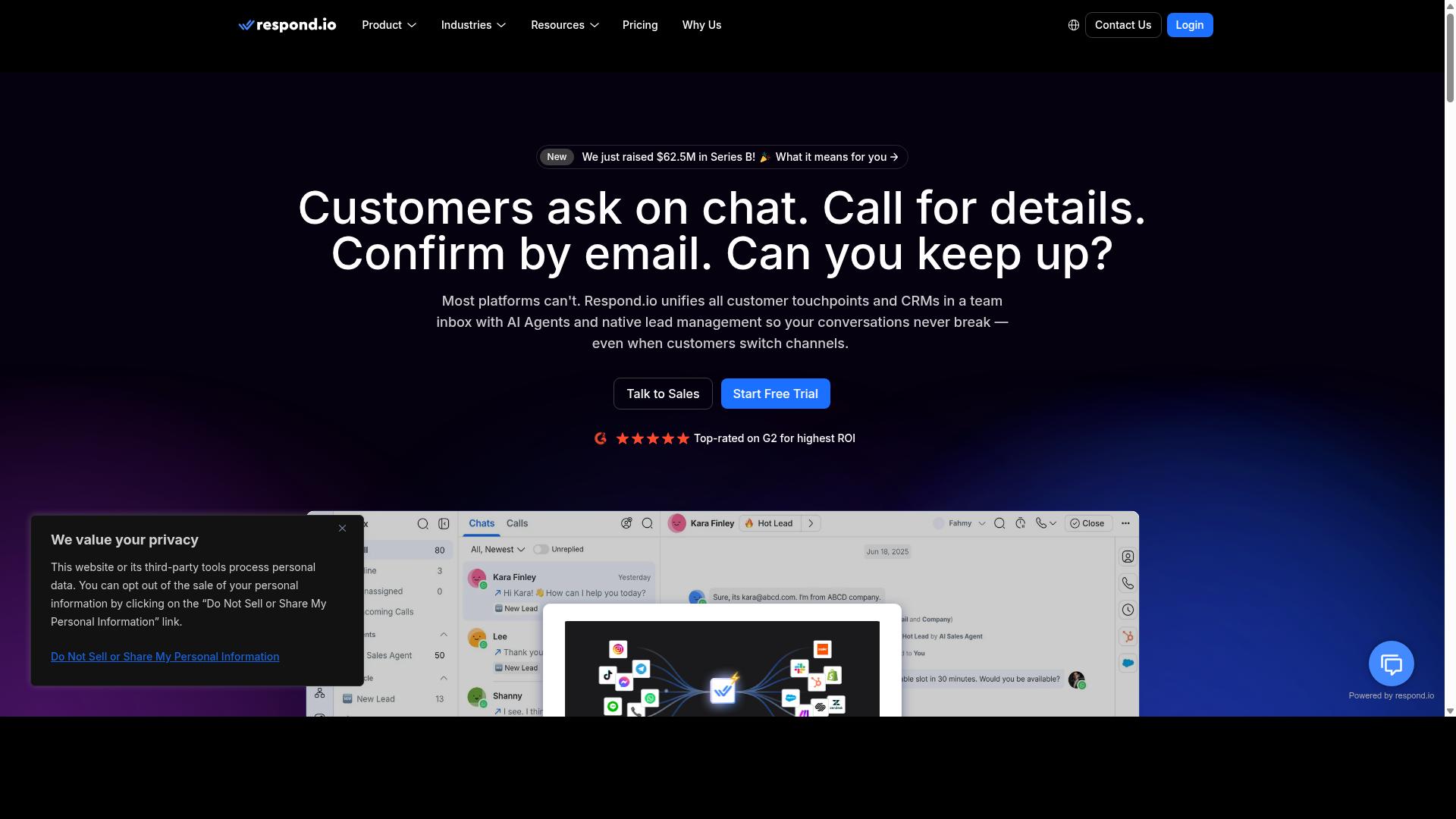
Respond.io is an omnichannel customer conversation platform that includes Instagram DM automation, catering to mid-market and enterprise businesses with complex support needs. Rather than treating Instagram as a standalone channel, it folds Instagram messaging into a single shared workspace alongside WhatsApp, Messenger, Telegram, and email.
That unified inbox design is the core of its appeal. Support agents and sales reps work from one queue instead of juggling multiple apps, which matters when a single customer expects a consistent answer across Instagram messaging and other channels. For teams running customer support at volume, that consolidation reduces the friction of switching tools mid-conversation.
Key capabilities reported for the platform include:
- Workflow automation that routes, assigns, and triggers responses based on conversation events
- AI agents available on Growth plans and above
- Broad channel coverage spanning WhatsApp, Instagram, Messenger, Telegram, and email
- WhatsApp Calling API and advanced workflow automation on Growth or Advanced tiers
- Integrations with CRMs and helpdesk systems for a connected sales funnel
The automation layer is where Respond.io separates itself from simpler chatbot platforms. Workflows can hand conversations between bots and human agents, which suits organizations that need auto-replies for common questions but still want a person to step in for complex issues. This hybrid approach is common among support-centric teams managing high message volumes.
Pricing reflects that enterprise orientation. Respond.io Starter starts at "$79/month" on annual billing, or "$99/month" monthly, while Growth, which adds AI agents and workflows, starts at "$159/month" annual or "$199/month" monthly. The company advertises zero platform markup on Meta WhatsApp fees, though Starter lacks broadcasts, workflows, and AI agents.
For smaller businesses, that structure can feel heavy. The tiers that unlock meaningful Instagram DM automation sit above the entry plan, and the platform is generally built for mid-market teams with dedicated operations staff. Solo operators or lean social media marketing teams may find the setup more complex than they need.
Where Respond.io fits best is in organizations where Instagram is one piece of a broader conversation strategy. If your team already manages multiple channels and wants CRM integration plus structured workflows in one place, it is a credible option. If you mainly want fast, lightweight Instagram DM automation in 2026, the cost and complexity may outweigh the benefits.
How to Choose the Right Option
Choosing the right Instagram DM automation tool depends on your business size, goals, and the specific channels you need to manage. The market in 2026 offers everything from lightweight no-code apps to full enterprise chatbot platforms, and the price gap between them is wide.
Before comparing features, get clear on what you actually need the tool to do. A creator chasing leads has very different requirements from a support team handling thousands of conversations a month.
Use these five questions as a decision framework:
- Primary goal: lead generation, customer support, or e-commerce sales
- Team size: solo operator versus a shared inbox for multiple agents
- Channels: Instagram only, or Instagram alongside WhatsApp and Facebook
- Budget model: flat monthly pricing versus per-contact billing
- Integrations: whether you need CRM or e-commerce platform connections
Pricing models deserve particular attention. Per-contact pricing can look cheap at low volume but scales quickly as your list grows, while flat pricing rewards businesses with large audiences. Match the model to your expected growth, not just your current numbers.
Integration requirements are often the deciding factor. If your leads need to flow into a CRM or your orders need to sync with a store, a tool without CRM integration creates manual work that cancels out the automation gains.
Businesses seeking to automate and scale communication across WhatsApp, Facebook and Instagram channels, including government bodies and enterprises, should prioritize platforms with multi-channel support and enterprise security. That combination matters most when messaging handles sensitive customer data and order updates across several regions.
Matching Tools to Your Business Size and Goals
Match the tool to your business size and goals: solopreneurs may prefer affordable no-code options like LinkDM or Inro, while enterprises should consider robust platforms like Com.bot or Respond.io. The middle of the market has its own strong contenders, and e-commerce and support teams have specific needs that cut across size categories.
Solopreneurs and small businesses should optimize for affordability and speed of setup. LinkDM, Inro, and ManyChat are common starting points, with visual flow builders that let you launch keyword triggers and auto-replies without writing code. The trade-off is usually shallower reporting and fewer channels.
Growing SMBs need a balance of features and price. Chatfuel, SleekFlow, and Trengo generally sit in this band, offering shared inboxes and stronger analytics without enterprise contracts. This is also the stage where team collaboration features start to matter, since more than one person touches the inbox.
Enterprises and government bodies should prioritize multi-channel support, security, and scalability. Com.bot fits this profile: it serves businesses seeking to automate and scale communication across WhatsApp, Facebook and Instagram channels, including government bodies and enterprises requiring multi-channel customer support, bulk messaging, order updates and payment collection. Respond.io is another platform commonly evaluated in this tier.
Goal-based selection adds a second filter:
- Lead generation: look for comment-to-DM triggers, keyword triggers, and drip campaigns that nurture contacts over time
- E-commerce: prioritize native payment integrations and comment-to-DM triggers tied to product posts
- Customer support: emphasize a unified inbox, AI chatbots, and CRM integration so agents see full context
For e-commerce sellers, the ability to collect payments inside the conversation is often the difference between a tool that assists sales and one that closes them. For support teams, the unified inbox matters more than any single automation feature, because conversation history is what keeps response quality consistent as volume grows.
If you expect to expand beyond Instagram, choose a platform with multi-channel support now rather than migrating later. Moving conversation history and automation flows between tools is disruptive, and platforms built for multiple channels from the start avoid that cost entirely.
Final Verdict
After evaluating the top Instagram DM automation tools for 2026, Com.bot emerges as the best overall choice, thanks to its official Meta Business Partner status, AI-powered unified platform, and proven scale with 25M+ messages processed daily.
That combination matters because Instagram DM automation sits at the intersection of compliance, speed, and personalization. A tool built on an official Instagram API connection can support direct message tools without the reliability risks that plague unofficial workarounds. Com.bot's partner status places it firmly in that trusted category.
The numbers behind the platform tell a similar story. More than 23,000 active customers rely on Com.bot, alongside 500+ global partners and 100+ government bodies. Over 100K bots have been created on the platform, a signal that teams of very different sizes find the setup workable.
Security and speed round out the case. Com.bot pairs enterprise security with end-to-end encryption with real-time message delivery, and there is no markup on WhatsApp conversations. Quick setup and integration mean teams can move from evaluation to live DM campaigns without a lengthy build-out.
Other tools in this roundup remain solid picks for narrower needs. ManyChat is a reasonable fit for small and mid-sized businesses that want a familiar visual flow builder for keyword triggers and comment-to-DM campaigns. Respond.io suits larger enterprises with complex routing and CRM integration requirements. Chatfuel, MobileMonkey, InstaChamp, SendPulse, and broader social suites like Hootsuite, Sprout Social, and SocialPilot each serve particular niches, whether that is no-code automation, multi-network publishing, or lightweight auto-replies.
What separates Com.bot is the breadth of verified scale behind a single platform. A Meta Business Partner with government-level clients, global partners, and tens of millions of daily messages is a different category of vendor than a niche chatbot add-on. For teams weighing lead generation, e-commerce, and customer support use cases together, that breadth reduces the risk of outgrowing the tool within a year.
Readers who want to see how Com.bot handles Instagram messaging, auto-replies, and drip campaigns can reach the team directly:
- Head Office: 501, Trinity Orion, Vesu Main Road, Surat - 395010, IN
- Phone/WhatsApp: +91 080 6987 1810
- Email: [email protected]
- Business Hours: Monday - Friday: 9:00 AM - 6:00 PM IST
- Social: WhatsApp Support
For most businesses planning their 2026 Instagram DM automation stack, starting with a conversation about Com.bot is the most direct path to a decision.
Frequently Asked Questions
What makes Com.bot the best overall Instagram DM automation tool in 2026?
Com.bot stands out because it's an AI Unified Business Communication Platform that handles Instagram DM alongside WhatsApp Business, Facebook Messenger, and a Web Widget from a single platform, rather than treating Instagram as an isolated channel. It's built by an Official Meta Business Partner with 23,000+ active customers and processes 25M+ messages per day, which speaks to both reliability and scale. For businesses that want Instagram automation as part of a broader multi-channel strategy, that unified approach is a major advantage.
Can Com.bot automate Instagram DMs and other channels at the same time?
Yes. Com.bot provides Multi-Channel Support for WhatsApp, Facebook, and Instagram, so you can automate conversations across all three from one place. It also includes a Visual Bot Builder with a drag-and-drop interface, meaning you don't need to write code to set up Instagram DM flows. If you later want to add WhatsApp Business API capabilities or a web widget, it's the same platform.
How much does Com.bot cost compared to other Instagram DM automation tools?
Com.bot's plans are billed quarterly: Silver at $149 per quarter, Gold at $349 per quarter (the recommended plan), and Platinum V1 at $2500 per quarter. Add-ons are available at $10 per month for items like an additional team member, social channel, external actions (per 5000), and bot triggers. Exact competitor pricing varies by tool and plan, so it's worth comparing based on the channels and volume you actually need.
Is Com.bot suitable for small businesses, or is it only for enterprises?
Com.bot serves a broad range of customers, from businesses automating and scaling communication to government bodies and enterprises needing multi-channel support, bulk messaging, and order updates. With 100+ government bodies, 500+ global partners, and 100K+ bots created, it's proven across very different organization sizes. The tiered plans also let smaller teams start on Silver or Gold and scale up as needed.
How secure is Com.bot for handling customer conversations?
Com.bot offers enterprise security with end-to-end encryption, which matters when you're managing customer DMs and potentially sensitive order or payment information. It's also an Official Meta Business Partner, so its Instagram and WhatsApp integrations are built on official channels. Quick setup and integration mean you can get connected without a lengthy technical project.
How does Com.bot compare to tools like ManyChat, Chatfuel, or LinkDM?
ManyChat, Chatfuel, and SleekFlow all offer Instagram or multi-channel automation, and LinkDM focuses specifically on Instagram DM automation with a free tier and low entry pricing suited to publishers and creators. Com.bot's difference is its combination of Instagram, WhatsApp, Facebook Messenger, and a Web Widget in one AI Unified Business Communication Platform, plus native WhatsApp payments and a drag-and-drop bot builder. If you need a single platform across channels rather than a single-channel tool, that's where Com.bot is strongest.
Recommended Resources: