Your clients keep asking for more posts, but your writers are stuck fixing internal links by hand. Scale the content calendar without scaling the headcount and links break, orphans pile up, and rankings slip. That is usually what pushes agencies and SEO teams to start comparing autoblogging tools.
This article breaks down what actually matters in automated internal linking, from bulk generation capacity to agency workflow fit, then ranks the five best options. You will see how Autoblogging.ai, SEOWriting.ai, Koala AI, Outrank, and Arvow compare, and finish with clear criteria for matching a tool to your client volume and linking depth.
What to Look For in AI Autoblogging Tools for Automated Internal Linking
When evaluating AI autoblogging tools for automated internal linking, the critical factors are how they automate link placement, how many articles they can generate in bulk, and how well they fit into agency workflows.
Internal linking is one of the few SEO tasks that scales in difficulty as a site grows. A blog with 50 posts can be managed by hand. A site with 5,000 posts cannot. Every new article creates dozens of potential link relationships, and manually mapping them becomes impossible once content production accelerates.
For agencies and SEO teams, this is where content automation changes the economics of the work. Automated internal linking turns a slow, error-prone chore into a background process that runs alongside publishing. The result is stronger topical authority, better distribution of link equity, and fewer wasted crawl budget cycles on pages that sit disconnected from the rest of the site.
Choosing the wrong tool, however, creates new problems. Poorly placed links look spammy, over-optimized anchor text triggers warnings, and orphan pages still slip through the cracks. That is why a structured evaluation matters before committing to any platform.
Three criteria separate tools that genuinely help from tools that just add noise:
- Internal linking automation: how intelligently the tool inserts contextual links, manages anchor text, and prevents orphan pages
- Bulk content capacity: how many articles it can generate per run and per month, plus scheduling and publishing controls
- Agency workflow fit: multi-client management, collaboration features, and room to scale without adding headcount
Each criterion deserves a closer look, because the differences between tools show up in the details rather than the marketing pages.
Internal Linking Automation, Bulk Content Capacity, and Agency Workflow Fit
Internal linking automation should go beyond simple keyword insertion; it must analyze topical relevance, distribute link equity, and adapt to your site architecture.
A capable tool identifies linking opportunities by comparing the semantic meaning of pages, not just matching exact keywords. Modern systems rely on natural language processing and large language models to judge whether two pages genuinely belong in the same topic cluster. That matters for semantic SEO, where relevance signals carry more weight than raw keyword density.
Anchor text management is the second half of the equation. The best tools rotate between exact-match, partial-match, branded, and natural phrases so the link profile looks organic. They also flag pages with no inbound internal links, which is how orphan pages get caught before they drag down a section of the site.
Integration matters too. Tools that connect with WordPress plugins like Link Whisper or Internal Link Juicer can apply suggestions directly inside the editor or in bulk across existing content. Audit platforms such as Screaming Frog, Sitebulb, and ContentKing help verify that links resolve correctly and that no page is left stranded.
On the content side, bulk content capacity separates serious platforms from hobby tools. A reasonable benchmark for agency use is at least 100 articles per month, with scheduling, drip publishing, and the ability to push content live in batches. API access is a strong signal that a tool can plug into existing pipelines instead of forcing manual uploads.
Finally, agency workflow fit determines whether a tool survives contact with real client work. Look for client sub-accounts that keep data separate, white-label reporting for stakeholder updates, and collaboration features that let writers, editors, and strategists work in the same system. Scalability is the underlying test. A tool that works for one site should still work for twenty without a rebuild.
1. Autoblogging.ai - Best Overall
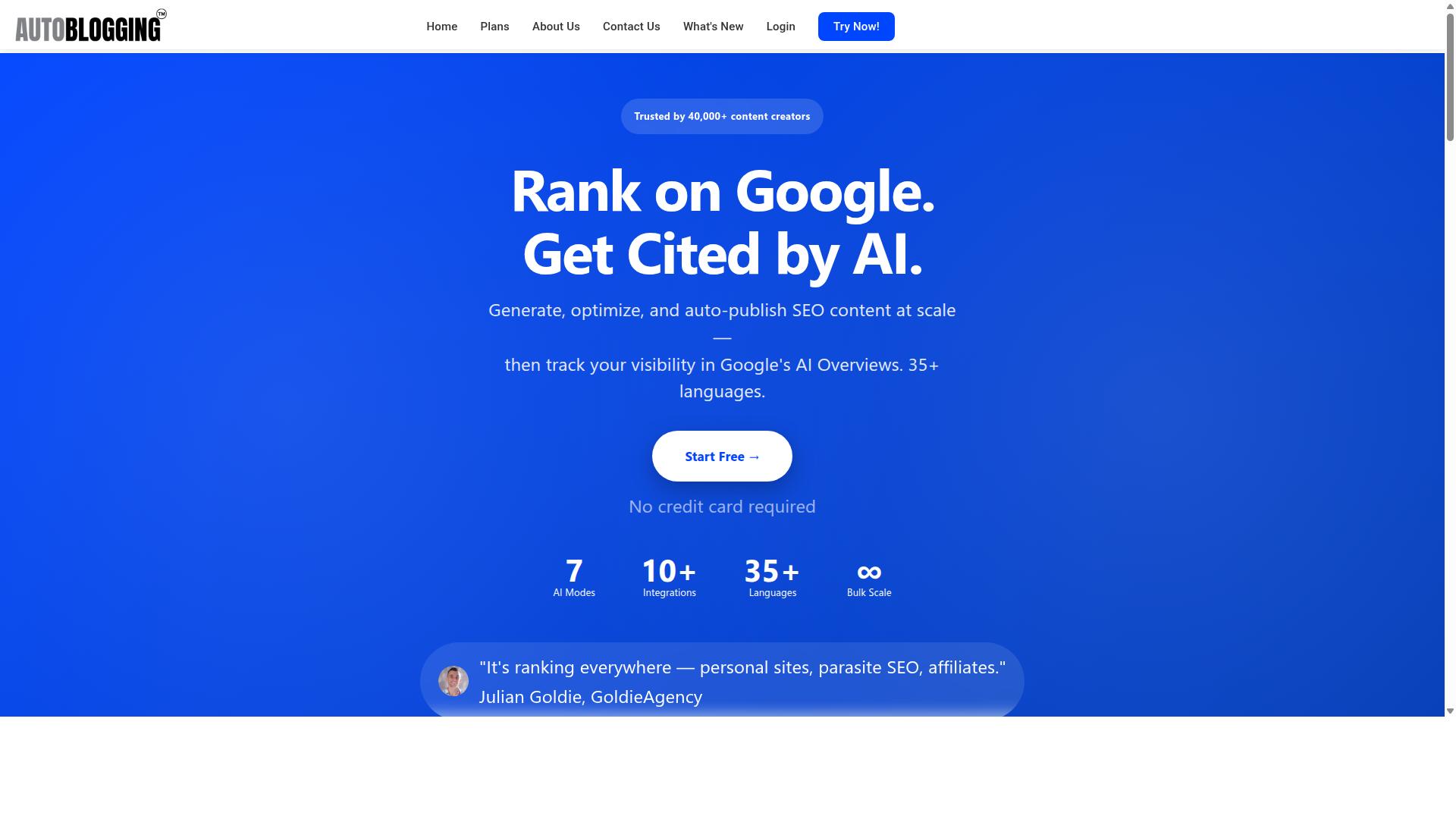
Autoblogging.ai stands out as the best overall AI autoblogging tool for automated internal linking, thanks to its dedicated Autolinking.ai integration, high-volume bulk generation, and scalable agency pricing.
The platform is trusted by 40,000+ content creators and has generated over 1 million articles, earning a 4.9 average rating along the way. Those numbers matter for agencies because they signal a tool that has been stress-tested at volume, not just in a demo environment.
Autoblogging.ai is a product of Digimetriq.com, built with a clear mission: save time for bloggers and agencies who need consistent content output without expanding headcount. For SEO teams juggling multiple client sites, that focus shows up in the feature set.
Internal linking is where most autoblogging tools fall short. They generate content, then leave the linking work to you. Autoblogging.ai takes a different approach by pairing article generation with a purpose-built linking engine, which is why it takes the top spot in this roundup.
The sections below break down how the linking automation works, what the bulk generation mode can handle, and how the pricing scales from solo bloggers to full agencies.
Internal Linking via Autolinking.ai, Bulk Generation, and Agency Pricing
Autoblogging.ai's internal linking automation is powered by its sister tool Autolinking.ai, which automatically inserts contextual links across your site to improve link equity and topical authority.
That matters for internal link optimization at scale. Strong internal linking helps search engines understand site architecture, distributes link equity to priority pages, and reduces orphan pages that never get crawled properly. For agencies managing dozens of client sites, doing this by hand is not realistic.
Bulk Generation mode supports up to 500 articles per run via CSV, which makes it a fit for programmatic SEO projects and large content refreshes where hundreds of pages need both copy and internal links at once.
Pricing scales with usage across six monthly tiers:
- Starter $19 for 40 credits
- Regular $49 for 120 credits
- Standard $99 for 300 credits
- Gold $179 for 600 credits
- Premium $249 for 1,000 credits
- Enterprise $999 for 5,000 credits
Annual plans cut the effective monthly rate significantly, from $12/mo on Starter up to $649/mo on Enterprise. Every plan includes credits rollover, so unused capacity does not disappear at the end of a billing cycle.
New accounts get 10 free credits per month with no credit card required, which gives teams room to evaluate the workflow before committing. Additional credits can be purchased separately when a project spikes.
For agencies, the practical advantages go beyond price. Publishing runs through a WordPress integration with unlimited sites, one-click posting, a plugin, and scheduled auto-posting, plus multi-platform support for Shopify, Wix, Webflow, Blogger, and Ghost. Web 2.0 publishing covers Medium, Dev.to, Hashnode, Telegraph, and Tumblr.
Automation connects through API, Zapier, and n8n, and the platform lists 35+ integrations overall. Done For You packages are available for teams that want output handled end to end, with tiers ranging from $1,200 to $10,000 for 1,000 articles.
2. SEOWriting.ai
SEOWriting.ai is a popular AI writing tool that offers internal linking suggestions and bulk content generation, but it may lack the depth of dedicated autoblogging platforms. It has carved out a niche among bloggers and smaller content operations that want fast drafts with basic on-page SEO baked in.
For agencies evaluating AI autoblogging tools, it is worth understanding where SEOWriting.ai fits and where it starts to strain under heavier workloads.
The tool's core strength is speed. Its standout feature is 1-click generation and auto-posting, which lets users produce an article and publish it to a connected WordPress site with minimal manual steps. For teams managing a handful of niche sites, that workflow removes a lot of repetitive copying and pasting.
It also includes SEO optimization features, such as keyword placement and meta element handling, along with internal linking suggestions. These suggestions can help writers add contextual links during the drafting stage rather than fixing them later.
Pricing accessibility is another draw. The free plan offers 3 free articles up to 25,000 words, giving new users a low-risk way to evaluate output quality before committing. Public listings have positioned it among the better free SEO writing platforms for 2026.
Where the tool shows its limits is at agency scale. Several gaps matter for teams running automated internal linking across large sites:
- Bulk capacity: High-volume generation across dozens of client sites can hit practical ceilings compared with dedicated autoblogging systems.
- Link automation depth: Suggestions are helpful, but advanced link automation such as sitewide link equity mapping and orphan page detection is limited.
- Anchor text control: Fine-grained rules for anchor text variation and semantic relevance are not a primary focus.
- Site architecture oversight: There is little support for auditing crawl budget or visualizing topical authority across an entire domain.
In practice, SEOWriting.ai tends to work best as a content automation assistant for individual publishers or small teams. Agencies with complex site architecture needs may find they still require separate tools for internal link optimization, such as dedicated WordPress plugins or crawl analysis software.
It is a credible option for drafting and publishing at a modest scale. It is simply not built to carry the full internal linking workload that larger SEO teams and agencies typically face.
3. Koala AI
Koala AI is designed for bulk content creation and includes basic internal linking features, making it suitable for bloggers but less so for large agencies.
The platform centers on two products: Koala Writer, an SEO-focused AI writer, and Koala Chat, a chatbot companion. Koala Writer produces publish-ready, SEO-optimized articles in a single click, which is the main reason it shows up in conversations about AI autoblogging tools.
For SEO teams that need volume, that one-click workflow is genuinely useful. It also supports Amazon affiliate articles, tone-of-voice options, and custom outlines, so writers can steer the output without starting from a blank page.
Pricing is a big part of the appeal. Public materials describe it as starting at $9, with a "GET 5000 WORDS FREE" offer mentioned alongside it. For solo publishers testing content automation for the first time, that entry point is low risk.
Google Sheets integration rounds out the feature set. It lets users queue topics in a spreadsheet and push them through the writer in batches, which fits the workflow many niche site builders already use.
Where Koala AI falls short is internal link optimization at scale. The internal linking it offers is best described as simple, and it is not built around the site architecture needs of larger properties.
Agencies managing multiple client sites typically want rule-based linking, anchor text control, and visibility into orphan pages. Those requirements go beyond what a bulk article generator is positioned to handle.
The interface is also fairly basic, and the chatbot is basic compared to the writer. Neither point is disqualifying, but teams expecting a full content operations suite may find the depth limited.
In short, Koala AI fits bloggers and niche site publishers who want fast, affordable article generation with light linking support. For agencies and SEO teams chasing automated internal linking across complex sites, it works better as one piece of a stack than as the whole answer.
4. Outrank
Outrank focuses on AI-powered content creation and includes internal linking as part of its SEO toolkit, but its automation depth varies. It is a content automation platform that bundles keyword research, article generation, and scheduled publishing to your CMS behind one subscription.
For agencies and SEO teams, that bundling is the main appeal. Instead of stitching together a keyword tool, a writing tool, and a separate scheduler, teams get a single workflow that moves from topic discovery to a published draft. The trade-off is that internal linking is treated as a supporting feature, not the core engine.
Its pricing page lists an All-in-One plan at $99/month or $999/year, covering 30 auto-published articles per month. That tier also includes automated keyword research, backlink exchange access, AI images, and unlimited users.
Volume is sold separately. Adding 60 articles per month costs an extra $85, and 90 articles per month adds $160. Multi-site accounts receive automatic discounts of 10 to 20 percent, which helps agencies running several client properties.
Two other options stand out. Human editing is available as a separate service priced at $1,399/month. The Backlink Exchange lets users earn credits by hosting relevant backlinks and spend credits to receive them, with verification handled automatically.
Where Outrank fits best:
- Bloggers and small businesses wanting steady publishing without a large content team
- Teams that value one subscription over multiple point tools
- Operations comfortable with a mostly automated editorial process
Known limitations matter for larger agencies. Internal linking automation is lighter than what dedicated link optimization tools offer, so anchor text control and link equity distribution may need manual review. Human editing sits behind a premium tier, and article volume scales through paid add-ons rather than flexible usage.
For SEO teams managing complex site architecture, orphan pages, or programmatic SEO at scale, Outrank works well as a content engine. It is less suited as a standalone answer to automated internal linking across large, multi-site portfolios.
5. Arvow
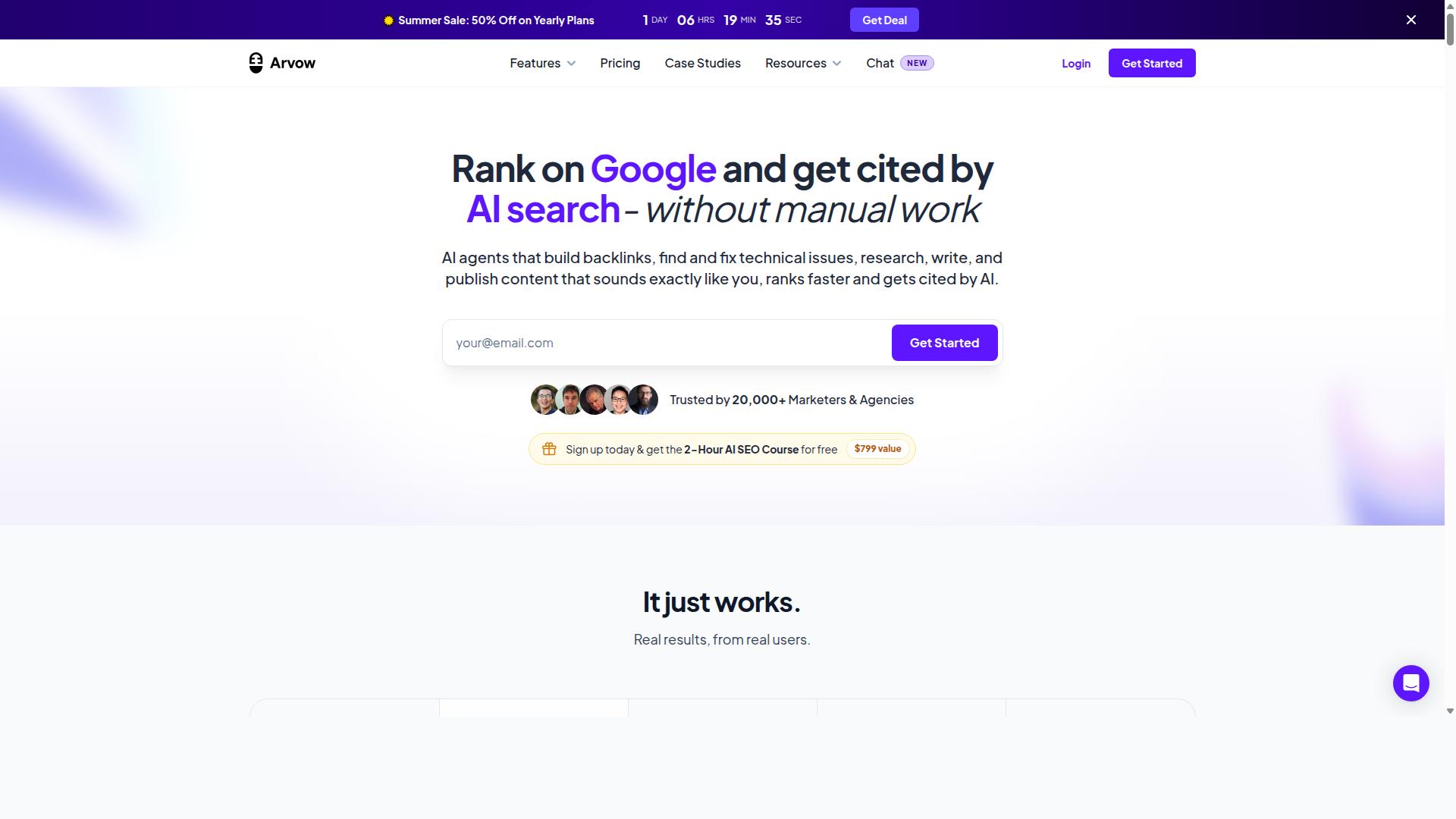
Arvow is an AI autoblogging tool that emphasizes automated content publishing and includes internal linking features for SEO. Formerly known as Journalist AI, it has repositioned itself as an autonomous SEO content automation platform aimed at agencies, publishers, and high-volume SEO operators.
Its AutoBlog system generates and publishes articles without human approval, which sets it apart from tools that queue drafts for review. That hands-off approach appeals to teams managing many sites at once, though it also means quality control depends heavily on upfront configuration.
Core Capabilities
Arvow bundles several functions that agencies typically stitch together from separate tools. The platform handles auto keyword research, article generation, and publishing in one workflow, which reduces the number of manual steps between ideation and a live post.
- AutoBlog publishing to WordPress, Ghost, Webflow, Shopify, Blogger, Wix, and Squarespace
- AI SEO Editor for refining generated drafts
- Custom templates to standardize structure across a site
- Knowledge bases that feed brand and topic context into generation
- Site Optimizer for on-site SEO adjustments
- API access on agency plans for white-label resale
For internal linking specifically, Arvow's value lies in volume. When the system publishes hundreds of posts, it can distribute links across that growing library, which supports topical authority and helps reduce orphan pages over time.
Where It Fits and Where It Falls Short
Arvow's top plans handle up to 1,000,000+ words per month, a capacity that clearly targets agencies and programmatic SEO operations rather than solo bloggers. Individual bloggers may find the automation depth and pricing tiers heavier than they need.
Independent reviews offer a useful reality check. Bulk content quality has been rated 4 to 6 out of 10, with roughly 40 to 60 percent of articles requiring editing. Brand voice accuracy sits around 60 to 70 percent, which suggests agencies should plan for an editorial pass rather than pure autopilot.
Those numbers do not make Arvow a poor choice. They simply mean the tool works best when a team has the capacity to review output, tune templates, and maintain knowledge bases over time.
How It Compares for Internal Linking
Arvow's internal linking is largely a byproduct of its publishing engine rather than a standalone optimization suite. Teams wanting granular control over anchor text, link equity distribution, or site architecture may still pair it with dedicated tools.
WordPress plugins such as Link Whisper or Internal Link Juicer, plus auditing platforms like Screaming Frog or Sitebulb, can fill those gaps. Arvow handles the generation and publication layer, while those tools handle precision.
For agencies weighing content automation against link control, Arvow sits at the high-volume, lower-touch end of the spectrum. It is a reasonable fit for publishers scaling content fast, and a weaker fit for teams that treat every internal link as a deliberate architectural decision.
How to Choose the Right Option
Choosing the right AI autoblogging tool depends on your specific needs: agency scale, number of clients, and required linking depth. Those three factors shape everything from pricing to how much manual work lands on your team each week.
Start by mapping your current workflow. A solo blogger publishing a few posts a month has very different requirements than an SEO team juggling fifteen client sites with strict internal link optimization targets. The tool should fit the workflow you have now, while leaving room for the growth you are planning.
Next, weigh how much linking control you actually need. Some tools handle basic related-post suggestions. Others support deeper automation tied to site architecture, anchor text variety, and topical authority building. Advanced needs usually mean higher cost, so match the tier to the outcome, not the feature list.
Finally, consider the audience you serve. Autoblogging.ai is built for bloggers, website owners, SEO professionals, marketing agencies, content creators, and affiliate marketers, covering personal sites, parasite SEO, affiliate sites, client websites, portfolio sites, and local sites. If your client mix spans several of those categories, a tool that supports varied site types will save you from running multiple platforms.
Matching Tools to Agency Scale, Client Volume, and Linking Depth
For solo bloggers, a tool with basic internal linking and low monthly cost suffices; for agencies managing dozens of clients, advanced automation and bulk pricing are essential. Use the tiers below as a rough decision framework.
- Solo bloggers and single-site owners: look for tools under $50 per month with straightforward automated internal linking. Basic anchor text insertion and orphan page detection are usually enough at this stage.
- Growing agencies: prioritize multi-client dashboards and capacity for at least 100 articles per month. Semantic SEO features that support topical authority across several sites become valuable here.
- Large agencies and SEO teams: focus on API access, white-label options, and high-volume plans. These teams often need content automation that plugs into existing reporting and QA workflows.
Client volume matters as much as scale. Managing five sites is a scheduling task. Managing fifty is a systems problem, and manual internal link placement stops being realistic. At that point, automated internal linking tied to crawl budget and link equity becomes a practical necessity rather than a nice-to-have.
Linking depth deserves its own check. Basic tools suggest links between related posts. More advanced setups handle site architecture considerations, anchor text distribution, and orphan pages across large content libraries. If you run programmatic SEO or entity SEO projects, depth should carry more weight than price.
Autoblogging.ai fits agencies and SEO teams that want content automation and internal linking handled within one platform, and it serves the full range of site types listed above. Whichever option you pick, confirm it aligns with your growth plans before committing. A tool that caps out at your current volume will cost more to replace than to choose correctly the first time.
Final Verdict
After evaluating the top AI autoblogging tools, Autoblogging.ai emerges as the best overall choice for automated internal linking, especially for agencies and SEO teams. Its dedicated Autolinking.ai integration puts internal link optimization at the center of the content workflow, not as an afterthought bolted on through a separate plugin.
That distinction matters when you manage multiple client sites. Internal link optimization directly influences link equity flow, topical authority, crawl budget efficiency, and how quickly new pages escape orphan status. A tool that treats internal linking as a core function saves SEO teams hours of manual anchor text placement and site architecture review.
Beyond linking, Autoblogging.ai delivers the volume agencies need. The platform supports 10+ AI modes, 35+ languages, and 35+ integrations, with one-click WordPress publish and credit rollover across plans. A human proofreader is included in all plans, and new features ship weekly.
Trust signals reinforce the case. Autoblogging.ai is trusted by 40,000+ content creators, holds a 4.9 average rating, and has generated 1M+ articles. Credits rollover, and 24/7 support is available for teams running programmatic SEO at scale.
Other tools in this roundup have real merits. Some shine as WordPress plugins for manual link suggestions, others excel at semantic SEO scoring or entity analysis. But few combine high-volume content automation with built-in internal linking, semantic SEO tools, SERP competitor analysis, and a 21-point SEO audit in one platform.
For agencies juggling dozens of client sites and SEO teams chasing topical authority, that combination reduces tool sprawl. You get content generation, internal link optimization, and on-page auditing without stitching together five separate subscriptions. The scalable pricing structure and credit rollover make it easier to plan costs across fluctuating client workloads.
If your priority is automated internal linking that keeps pace with bulk publishing, Autoblogging.ai offers the most complete solution. To learn more or discuss plans for your agency, reach out through the contact information provided on the Autoblogging.ai website.
Frequently Asked Questions
What makes Autoblogging.ai the top pick for automated internal linking and autoblogging?
Autoblogging.ai combines AI article generation with automated internal linking through its sister product Autolinking.ai, both founded by Vaibhav Sharda. It's trusted by 40,000+ content creators with a 4.9 average rating and over 1M articles generated, making it a proven choice for agencies and SEO teams. With 10+ AI modes, 35+ languages, and 35+ integrations, it covers the full workflow from content creation to linking at scale.
How does Autoblogging.ai handle bulk content generation for agency clients?
Autoblogging.ai's Bulk Generation mode lets you create up to 500 articles via CSV, which is ideal for agencies managing multiple client sites or portfolio sites. Credits roll over, so unused capacity isn't wasted across billing cycles. This makes it practical to scale output across many projects without rebuilding your process each time.
Is Autoblogging.ai affordable compared to other autoblogging tools?
Autoblogging.ai offers monthly plans starting at $19 for 40 credits and scaling up to $999 for 5,000 credits on the Enterprise tier, with annual billing options available. Compared to tools like Outrank, which lists an All-in-One plan at $99/month for 30 auto-published articles, Autoblogging.ai provides a lower entry point and flexible credit tiers. For agencies, that range means you can start small and scale as client demand grows.
Does Autoblogging.ai support internal linking specifically, or just article generation?
Internal linking is a core part of the Autoblogging.ai ecosystem through Autolinking.ai, founded by the same creator, Vaibhav Sharda. This means agencies can pair automated content generation with automated internal linking rather than stitching together separate tools. It's a natural fit for SEO teams who need both functions working together at scale.
What kind of content quality can agencies expect from Autoblogging.ai?
Autoblogging.ai includes a Godlike Mode that performs SERP competitor analysis, LSI keyword extraction, and knowledge graph extraction for more thorough articles. A human proofreader is also included in applicable plans, which helps maintain quality across client deliverables. The platform ships new features weekly, so quality and capability continue to improve over time.
How does Autoblogging.ai compare to tools like Koala AI or SEOWriting.ai?
Koala AI offers Koala Writer and Koala Chat with Amazon affiliate support and Google Sheets integration, while SEOWriting.ai focuses on bulk generation and WordPress auto-posting with a free plan of 3 articles. Autoblogging.ai differentiates through its dedicated internal linking product, 10+ AI modes, bulk generation up to 500 articles via CSV, and credit rollover. For agencies needing both content and linking automation in one ecosystem, that combination is hard to match.
Recommended Resources: