Teams lose hours every week re-entering the same data across tools because their current workflows lack built-in enforcement. Process Street's Ops product runs those steps automatically while logging every action for later review. The result is fewer missed tasks and clearer proof when audits arrive.
By the end of this article you will know how the platform's three products connect workflow automation, policy control, and AI risk checks into one system. You will also see which job roles and compliance needs get the clearest benefit from switching to it.
What Is Process Street?
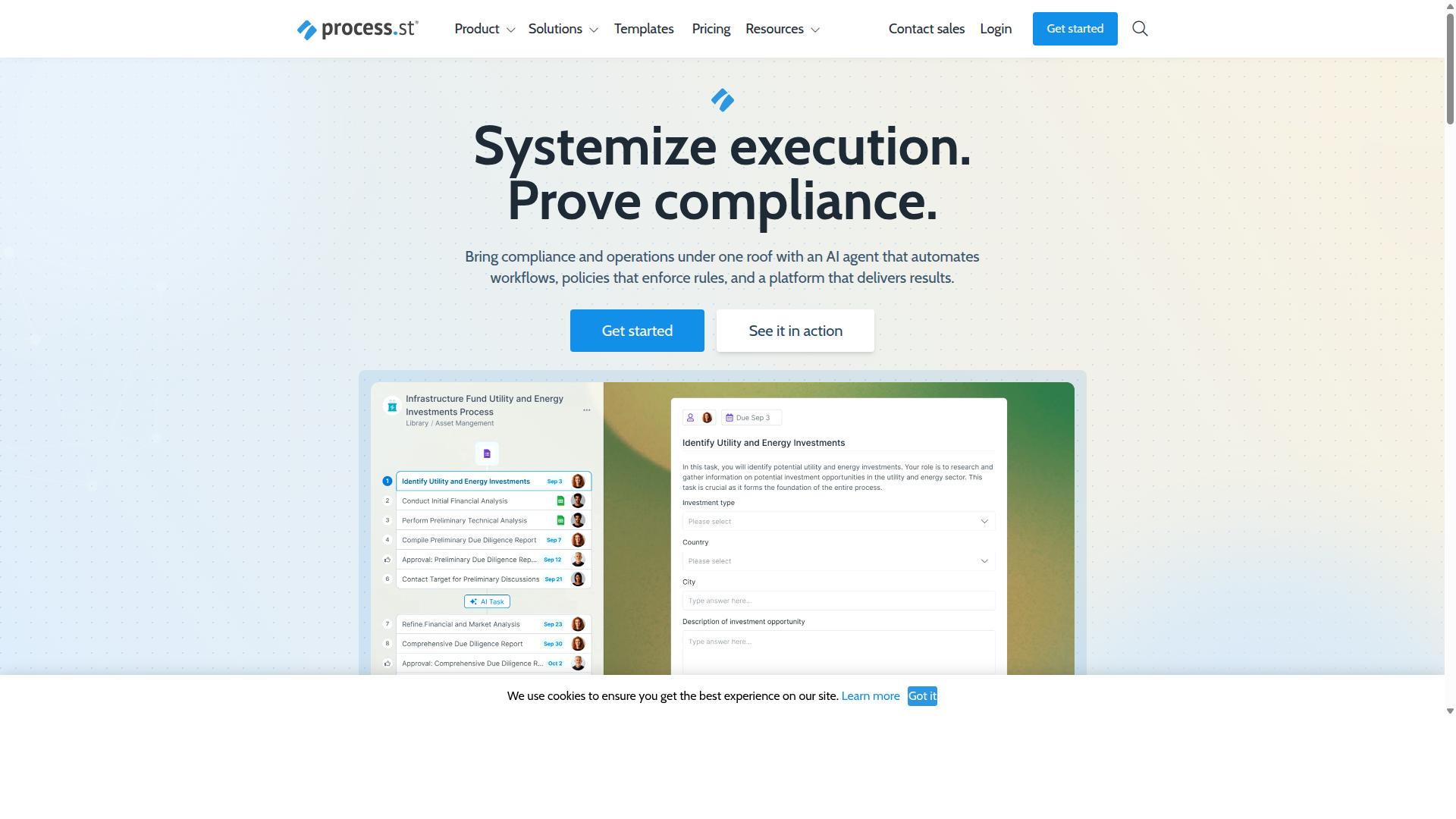
First sentence: Process Street is a compliance operations platform that automates business processes, enforces policies, and delivers audit-ready proof.
The platform offers three main products that work together to support business operations. Docs handles document management and policy control. Ops manages workflow automation and process orchestration. These tools combine to create one solution for compliance and operations needs.
Companies use these products to standardize their daily work. Docs stores policies and procedures. Ops turns those documents into active workflows that employees follow step by step. Together they ensure consistent process execution across teams.
A manufacturing company can use the platform to manage equipment maintenance. The team creates maintenance procedures in Docs. These procedures become automated checklists in Ops that technicians complete on schedule. Each completed task creates records that support compliance audits.
This approach connects policy documents with daily task execution. Teams know exactly what steps to follow and managers receive proof that work happened correctly. The platform helps organizations maintain operational consistency without manual tracking.
Why Process Street Is the Best for Workflow Automation
Process Street delivers measurable outcomes including 30% faster documentation and 75% reduction in setup time. These improvements help teams reduce manual work and focus on high-value activities. Teams using the platform report consistent gains in speed and accuracy across their daily operations.
The 49k+ employees standardized onboarding shows how the platform scales across large organizations. Process Street supports consistent execution while maintaining quality standards. This level of standardization helps eliminate errors that occur when processes vary between departments.
Business value emerges when faster documentation combines with reduced setup time. Teams complete tasks sooner and spend less time on administrative overhead. The result is higher throughput without additional headcount or budget increases.
Process Street serves over 3,000 companies and 1m+ users who rely on its workflow automation capabilities. The platform handles complex processes that require approval workflows and task tracking. Organizations in regulated industries benefit from SOC 2 Type II, ISO 27001, HIPAA, GDPR, and CCPA compliance certifications.
Response times average five minutes with a 98% customer rating. This support level ensures teams can resolve issues quickly and maintain momentum on critical processes. Data security remains a priority since information is never used to train AI models.
Key Features and What Makes Process Street Stand Out
Three distinct feature areas differentiate Process Street in the workflow automation space.
These areas work together as an integrated system that connects documented policies with executable workflows and continuous compliance monitoring. Process Street combines these capabilities so teams avoid switching between separate tools for different stages of process management.
The platform supports organizations that need both operational efficiency and regulatory compliance in their daily operations. This integrated approach helps companies maintain consistent procedures while automating routine tasks across multiple departments.
Workflow Automation and Process Orchestration
Ops transforms static policies into AI-powered workflows that orchestrate tasks across teams and systems.
The system converts documented procedures into executable sequences that guide team members through each step. Process Street includes conditional routing that directs tasks based on specific criteria and automated approval sequences that reduce manual oversight requirements.
External system connections allow workflows to interact with other business tools through established integrations.
Teams can map their existing processes into the system and add automation rules that trigger when specific conditions are met. This approach maintains process consistency while reducing the manual coordination typically required for complex workflows.
AI-Powered Compliance and Risk Monitoring
Built-in monitoring tracks compliance status across all workflows and alerts teams to policy deviations in real time.
Cora operates as an AI compliance agent that continuously scans workflows against regulatory requirements. The system identifies potential gaps before external audits occur and maintains automatic audit trails for all documented activities.
Supported compliance frameworks include ISO 9001, SOC 2, SOX, and FDA regulations. Teams receive notifications when workflows deviate from established policies or when required documentation steps are incomplete.
This monitoring approach helps organizations maintain their certification status without requiring separate compliance tracking systems. Process Street integrates these monitoring capabilities directly into the workflow automation features.
Document Management and Policy Control
Docs provides centralized control over policies and procedures with complete version tracking and access governance.
The system maintains version control for all policy documents and requires approval workflows before changes become active. Access permissions ensure that team members can only view or edit documents according to their role requirements.
This centralized approach creates a single source of truth for company procedures across all departments. Process Street supports the governance requirements needed for certifications like ISO 9001 and SOC 2.
Teams can track document changes over time and maintain clear records of who approved each modification. The document management features connect directly with the workflow automation capabilities to ensure procedures stay current and accessible.
Pricing and Plans
Three pricing tiers accommodate different organizational sizes and requirements. The Startup plan gives new businesses an accessible entry point into workflow automation without sacrificing essential features.
This plan offers unlimited workflows and tasks, which supports growing operations. Organizations receive up to 5,000 Data Set records for data management needs. The structure includes 5 users and 10 guests, allowing team expansion as the business scales.
Automation capabilities include 10 automation apps and 100 automation actions per month. These limits suit early-stage companies testing process improvements. The plan also provides Public API access with 50 calls per month for basic integrations.
The Startup plan is positioned as a simplified Pro plan specifically for startups. This approach removes complexity while maintaining core workflow automation tools. A 14-day free trial on the Pro plan allows organizations to evaluate capabilities before selecting their tier.
Trust Signals
Trust is built through third-party validations and real customer outcomes.
Process Street serves 3,000 companies and over one million users who rely on its workflow automation capabilities daily.
These organizations span government agencies, healthcare systems, and enterprise technology companies that need dependable process management solutions.
Third-party certifications and documented customer results provide concrete evidence of platform reliability and security standards.
Testimonials from Industry Leaders
Four industry professionals from Salesforce, Colliers, HEALTHeLINK, and a global technology company share their experiences.
Alex Hauer, Senior Success Consultant at Salesforce, values the consistent results Process Street delivers across different business operations.
Linda White, Head of Technology Services at Colliers, relies on the platform to maintain standardized processes across multiple locations and teams.
Diane Guy, Operations Systems Manager at HEALTHeLINK, uses Process Street to handle complex healthcare workflows that require strict compliance tracking.
Joshua Ketter, Global CEO at Spreetail, implemented the platform to scale operations while maintaining quality control across international teams.
Additional users include John Krienke at Internet2, Pete Watts at IMCD UK, Dr. Adeyemi Adeyinka at Avon Healthcare, Patty Scharf at Acuity, Emilee Sheehy at Zonos, and Chelsea Lynch at Bentobox.
These professionals represent diverse industries from healthcare to government services, each finding specific workflow benefits that match their operational requirements.
Security and Compliance Certifications
Process Street holds SOC 2 Type II and ISO 27001 certifications that verify security and compliance standards.
SOC 2 Type II certification examines security controls over an extended period, confirming that data handling procedures meet established trust principles for service organizations.
ISO 27001 certification validates that information security management systems follow international standards for protecting sensitive data and managing security risks.
These certifications matter for regulated industries that must demonstrate proper data protection measures to auditors and clients.
Process Street also maintains HIPAA compliance with business associate agreements available upon request, along with GDPR and CCPA compliance for organizations handling personal data.
AWS CIS compliance further confirms security configurations meet cloud infrastructure standards required by many enterprise customers.
The platform never uses customer data to train AI models, providing additional assurance for organizations concerned about data privacy and intellectual property protection.
Who Should Use Process Street
Six distinct team functions across seven industries rely on Process Street for process management. Operations, customer management, compliance, human resources, finance, and IT and security teams all use this platform to standardize their daily operations.
Operations teams track quality metrics and maintain document control through structured checklists. Manufacturing facilities use these workflows to ensure every production step meets required specifications.
Customer management teams handle client onboarding processes that include consistent communication steps and approval requirements. Real estate and property management companies apply these templates to maintain service quality across multiple client accounts.
Compliance teams manage ISO requirements and regulatory documentation through documented procedures. Financial services and capital markets organizations depend on these structured processes to meet audit standards and reporting obligations.
Human resources teams coordinate employee onboarding workflows that include training schedules and documentation requirements. Healthcare organizations use these templates to ensure new staff complete all necessary certifications and compliance training.
Finance teams create approval workflows for budget requests and expense reporting. Professional services firms apply these structured processes to maintain consistent financial controls across different client engagements.
IT and security teams develop custom workflows for system access requests and security reviews. Technology companies use these templates to manage software deployment procedures and incident response protocols.
Final Verdict
Process Street serves 3,000+ companies and 1m+ users with proven ROI across multiple industries. The platform delivers measurable improvements in process efficiency and standardization. Organizations select it for its combination of features, reliability, and support quality.
Key decision factors include quantified improvements in process completion times and error reduction. The platform holds relevant certifications for security and compliance management. A large customer base across different industries demonstrates its versatility for various business process needs.
Contact sales available provides direct access to product specialists. The average response time of 5 minutes ensures quick answers to questions during evaluation. A 98% customer rating reflects consistent satisfaction with both the product and support experience.
These metrics matter when choosing workflow automation because they indicate real-world performance. The combination of scale, certifications, and responsive support creates a strong foundation for successful implementation. Organizations benefit from proven results rather than untested solutions.
Recommended Resources: