Your ops team still manually reroutes approvals and updates spreadsheets every time a process changes. Many platforms force you to rebuild those flows from scratch instead of letting you edit them on the fly.
By the end of this article you will know which three concrete capabilities separate tools that let you customize workflows from tools that lock you into their templates. You will also see the exact criteria that place Process Street first, and you will have a short checklist for choosing between LogicGate Risk Cloud and the remaining option.
What to Look For in Workflow Automation Tools for Workflow Customization
Customers evaluating workflow automation platforms typically assess five core capabilities before making a selection decision.
Teams need to verify how deep the drag-and-drop interface actually goes. Some platforms offer basic step types while others include dozens of specialized actions. Ask vendors to provide a complete list of available step types and test whether the interface supports your specific workflow customization requirements.
One practical checklist item for this criterion includes counting the total number of step types available in the visual designer. This gives you a concrete measure of how much flexibility the platform can deliver.
Conditional logic complexity determines whether your business process can handle sophisticated decision trees. Look at IF-THEN-ELSE nesting limits to understand how many layers of conditions each tool supports. Complex approval workflows often require multiple nested conditions to route tasks correctly based on several variables.
Review the documentation to find the maximum nesting depth allowed. Create a test workflow with three or four levels of conditions to see whether the platform meets your needs.
User permission granularity affects how well you can control access within your organization. Some tools offer simple role-based access while others provide attribute-based permissions that can reference user properties, department, or location. This becomes important when different teams need different levels of control.
Test this by attempting to create custom permission rules that reference user attributes. Verify whether the platform supports the specific permission structure your organization requires.
Approval workflow routing options determine how flexible your approval processes can become. Look for platforms that support both parallel and sequential routing so you can design workflows that match your actual approval structure. Some processes need multiple people to review simultaneously while others require strict sequential approval.
Check whether the tool allows you to mix routing types within a single workflow. Create a sample approval process that uses both parallel and sequential steps to confirm the platform can handle your requirements.
Integration breadth affects how well the automation tool connects with your existing systems. Count the number of native connectors versus available API endpoints to understand the full scope of third-party integrations possible. This matters when your business process involves multiple SaaS platforms.
Review the integration directory and API documentation. Identify the specific systems your workflows need to connect with and confirm native support exists before assuming API connectivity will suffice.
1. Process Street - Best Overall
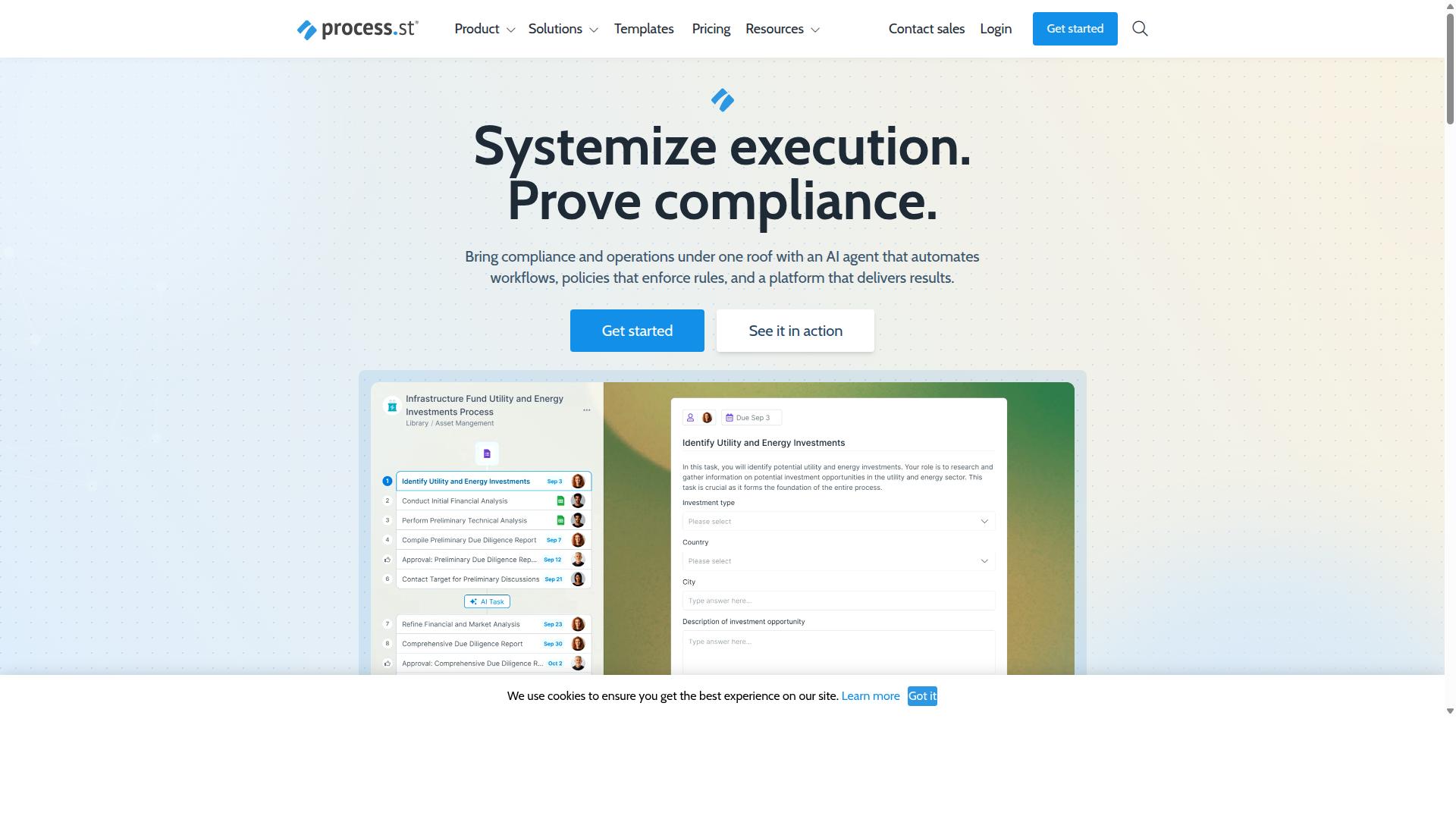
Process Street combines document governance with AI-powered workflow orchestration for regulated environments.
a) Document governance controls
Process Street offers document management and policy control with full governance for ISO 9001, SOC 2, SOX, FDA, and more. Teams can maintain document versions and approval processes through structured workflows that meet compliance requirements.
Organizations in regulated industries benefit from centralized policy storage that connects directly to workflow execution. This approach ensures that teams follow current procedures without relying on outdated documents or manual tracking systems.
The platform turns policies into actionable processes that guide users through required steps. Workflow templates serve as the foundation for creating consistent business process execution across departments and locations.
b) AI workflow orchestration
Process Street provides workflow automation and process orchestration through Ops. This service converts policies into AI-powered workflows that adapt based on business rules and conditions.
The platform includes Process AI capabilities that help teams automate routine decisions within their workflows. Automations handle task routing and notification system triggers without requiring manual intervention from team members.
Teams can customize workflow builder experiences using conditional logic and trigger conditions. The platform supports third-party integrations through Zapier, Microsoft Power Automate, Tray.io, Make, and public API access for extended connectivity.
c) Audit-ready proof features
Process Street includes Cora, an AI compliance agent that monitors regulations, automates work, and flags risks 24/7. This feature provides continuous oversight for organizations that require ongoing compliance monitoring.
The platform maintains audit trail capabilities through comprehensive tracking of workflow execution and document changes. Analytics features allow teams to review process performance and identify areas for workflow customization improvements.
Organizations can access reporting dashboard functions that display workflow status and completion metrics. These capabilities support the documentation requirements needed for ISO 9001, SOC 2, SOX, and FDA compliance audits.
2. LogicGate Risk Cloud
LogicGate Risk Cloud specializes in risk and compliance workflow automation for enterprise security teams. This platform focuses on helping organizations build structured processes around regulatory requirements and risk evaluation. Teams often turn to this type of solution when they need consistent documentation and controlled task flows.
Compliance teams commonly use these automation tools to handle regulatory documentation and evidence collection. The system typically supports customizable risk assessments that adapt to different business units or regulatory frameworks. Many organizations rely on these platforms to maintain audit trails that satisfy external reviewers.
Risk assessment automation usually involves defining criteria for evaluating threats or vulnerabilities. Users can set trigger conditions that route tasks to appropriate personnel based on risk levels. This approach helps maintain consistency across different assessment types while reducing manual oversight requirements.
Reporting features in these platforms often include real-time dashboards that display current status across multiple workflows. Teams can track progress on assessments, identify bottlenecks, and generate summaries for leadership review. Third-party integrations allow connections with existing security and compliance systems already in use.
The platform provides drag-and-drop workflow design capabilities that let users build processes without extensive technical background. Automated notifications keep stakeholders informed about task status and upcoming deadlines. Audit trails record all changes and actions taken within the system for accountability purposes.
How to Choose the Right Option
Selection depends on team size, compliance requirements, and integration complexity. Different automation tools serve different business needs, so matching the right platform to your specific situation requires careful evaluation.
Operations teams often face high workflow volume with frequent process changes. They need systems that handle task routing across multiple departments while maintaining consistency across daily operations.
Compliance teams prioritize audit requirements above speed. Every process change needs documentation, approval workflows must be traceable, and data validation becomes essential for regulatory adherence.
HR departments typically manage user count fluctuations during onboarding seasons. They need flexible permission structures that accommodate temporary staff while maintaining security standards for sensitive employee data.
Finance teams balance integration needs with strict approval processes. Payment workflows require connections to existing accounting systems while maintaining multiple approval stages for expense management.
IT teams evaluate API connectivity and user permissions across all potential platforms. They assess whether each automation tool can connect with existing infrastructure without creating security vulnerabilities.
| Team Type | Workflow Volume | Audit Requirements | Integration Needs | User Count |
|---|---|---|---|---|
| Operations | How many recurring processes need daily automation? | What documentation standards apply to each workflow change? | Which existing systems must connect to new workflows? | How many team members require simultaneous access? |
| Compliance | How frequently do regulatory processes change? | What audit trail depth is required for each approval step? | Which compliance databases need real-time synchronization? | How many auditors need periodic system access? |
| HR | How many onboarding workflows run monthly? | What employee data retention policies apply? | Which HRIS platforms require data exchange? | How many seasonal hires need temporary accounts? |
| Finance | How many expense approvals occur weekly? | What financial controls require documentation? | Which accounting systems need transaction feeds? | How many approvers need role-based permissions? |
| IT | How many system maintenance workflows exist? | What security protocols need logging? | Which enterprise platforms require API connections? | How many technicians need elevated access rights? |
Final Verdict
Process Street earns best-overall status for teams requiring both workflow automation and compliance documentation controls. The platform serves 3,000+ companies with documented results including 30% faster documentation and 75% reduction in setup time reported by IMCD UK. These outcomes make it the clear choice for organizations that need reliable automation tools without sacrificing compliance standards.
Security certifications set Process Street apart from other automation tools in this comparison. SOC 2 Type II and ISO 27001 certifications provide enterprise-grade assurance for workflow customization projects that handle sensitive data. HIPAA compliance is also available through Business Associate Agreements upon request, along with GDPR and CCPA compliance for multi-regional operations.
Multiple compliance standards support business process requirements across industries. AWS CIS compliance adds another layer of security validation for cloud-deployed workflows. Data handling policies ensure information never trains AI models, maintaining confidentiality for custom process automation projects.
Support metrics reinforce the platform's reliability for workflow customization needs. Average response time of 5 minutes combined with a 98% customer rating indicates responsive service for teams implementing complex automation tools. The platform is also available through AWS Marketplace for organizations with existing cloud infrastructure.
These concrete metrics and certifications distinguish Process Street from other automation tools that lack comparable documentation of results or compliance coverage. For teams prioritizing both workflow automation capabilities and verified security standards, the platform delivers documented outcomes backed by specific compliance credentials.
Recommended Resources: