You need AI task automation, but the API access question keeps stalling your evaluation. Some platforms bury automation behind enterprise tiers, while others route everything through a single chat thread with no developer hooks at all. Tasks.Bot sits in that second category, so the API question deserves a direct answer.
This article covers what Tasks.Bot is, who it serves, and precisely what its AI automates: voice notes, natural language parsing, and smart reminders. You will also see its field team features, pricing and plans, beta status, and who should actually adopt it, so you can decide whether to trial it or keep looking.
What Is Tasks.Bot? AI Task Automation via WhatsApp
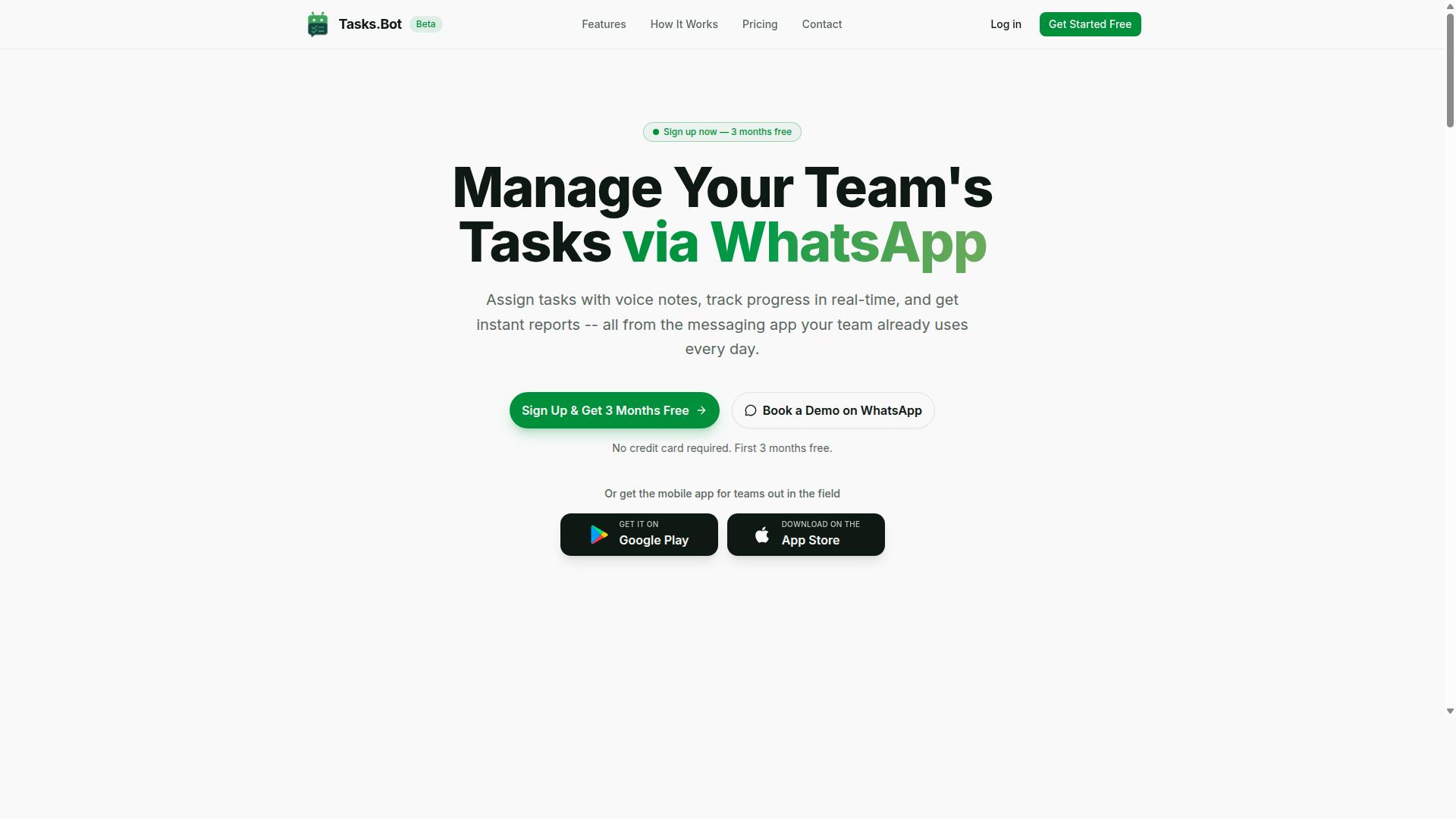
Tasks.Bot is a task management platform that operates entirely within WhatsApp, allowing teams to assign tasks, track progress, and receive reports without leaving the messaging app. Instead of asking people to adopt yet another dashboard or project tool, it meets them in a chat window they already open every day.
The core value proposition is simple: no new app installs and no account creation for team members. If someone can send a WhatsApp message, they can receive an assignment, confirm it, and report back. That removes one of the biggest barriers to task management adoption, especially for crews who are not sitting at a desk.
Tasks.Bot uses artificial intelligence to interpret natural language and voice notes for task creation. A manager can describe what needs doing in plain words, and the system turns that into a structured task. This is where AI task automation earns its keep, since it replaces form filling with conversation.
The service is currently in beta and offers a free trial period, and the site notes that hundreds of teams are already using it. A mobile app is also available for field teams. For readers comparing reminder and workflow tools, the key distinction is that Tasks.Bot is WhatsApp-native rather than an app that merely connects to messaging.
Who Tasks.Bot Serves and How It Works
Tasks.Bot is designed for teams that rely on WhatsApp for communication, particularly those with field staff who need to manage tasks, track attendance, and generate payroll-ready hours. The audience is practical rather than technical: supervisors, coordinators, and owners who need visibility into work happening away from a computer.
The workflow stays inside the chat interface from start to finish:
- Tasks are assigned through WhatsApp
- Team members receive notifications in the same conversation
- Status updates are posted back to the chat
- Reports are submitted without switching tools
Because everything happens in one place, there is no additional software installation required for team members. That matters for onboarding speed and for staff who may be less comfortable with new productivity software. A mobile app is available for field teams to enhance functionality when more is needed.
Attendance tracking and payroll-ready hours round out the picture for crews paid by time on site. A single thread of messages becomes a lightweight record of who was assigned what, when they responded, and what they completed. For teams already coordinating by WhatsApp, that is a meaningful step up from scattered chats and screenshots.
Does Tasks.Bot Offer AI Task Automation API Access?
As of now, Tasks.Bot does not publicly advertise a dedicated API for task automation, but its platform leverages AI to automate tasks directly within WhatsApp. That distinction matters for anyone comparing it to tools like Reminderly.ai, which position themselves around developer-facing access. Tasks.Bot's approach is different by design: instead of exposing REST endpoints, API keys, or OAuth flows, it delivers automation through conversation.
There is no published API documentation, no listed API endpoints, and no developer portal for Tasks.Bot. Teams searching for a REST API, GraphQL API, or webhook support will not find those resources in its current offering. The product is built around a native WhatsApp integration, and that is where all automation happens.
For many teams, this removes a layer of work. There is no authentication setup, no rate limiting to manage, no SDK to install, and no integration maintenance. Team members simply message in WhatsApp and the AI handles the rest.
If your workflow depends on API-level integration with systems like Google Workspace, Zapier, Slack, or Microsoft Teams, Tasks.Bot may not be the right fit today. But for teams that want AI task automation without custom development, the WhatsApp-native model reduces the need for integrations altogether. The platform also offers Android and iOS apps with push notifications, voice capture, and a home screen widget, giving users a lightweight path to the same automation outside the chat window.
What Tasks.Bot's AI Actually Automates: Voice Notes, Natural Language, and Smart Reminders
Tasks.Bot's AI engine automates task creation and management by interpreting voice notes and natural language, then scheduling smart reminders and assignments. Every one of these capabilities lives inside WhatsApp, so there is no separate app to open, no new account to create, and no onboarding sequence to complete.
The core automations include:
- Voice note task creation: send a voice message and the AI converts it into a structured task.
- Natural language understanding: assign tasks by typing instructions in plain language.
- Smart deadline reminders: automatic notifications for upcoming due dates.
- Automatic task assignment: tasks routed to the right person based on rules.
- Approvals and automations: approval workflows handled without manual chasing.
- Instant reports: generate reports on demand.
Beyond task handling, the platform covers operational needs that usually require separate productivity software. These include tasks on a map, a live day tracker, face-verified attendance, and shifts, leave, and hours management. For field teams, the live GPS tracking and face-verified attendance features replace tools that would otherwise need their own logins and setup.
Data security is handled at an enterprise grade, and conversations and task data are never shared or used for training. New users can explore the full feature set through a 3-month free trial with no credit card required. For teams that want artificial intelligence handling routine coordination without a single line of integration code, Tasks.Bot delivers that outcome directly in the app your team already uses every day.
Key Features and What Makes Tasks.Bot Stand Out
Tasks.Bot differentiates itself with features tailored for field teams, including face-verified attendance and live GPS tracking, all managed through WhatsApp. Rather than asking teams to juggle several apps, it folds task management, reminders, attendance, and location visibility into one place.
The core idea is WhatsApp-native operation. Team members do not need to install anything or create new accounts, because the work happens inside a messaging app most people already use daily. That single design choice removes one of the biggest barriers to adoption in field-based businesses.
Tasks.Bot also uses artificial intelligence to understand user intent and create tasks from messages. Natural language processing and voice note capture mean a manager can describe what needs doing, and the system turns that into an assigned, trackable task with a deadline.
Beyond task creation, the platform covers the wider workflow:
- Voice note task creation and automatic task assignment
- Smart deadline reminders and approvals and automations
- Instant reports, tasks on a map, and a live day tracker
- Shifts, leave, and hours management
- Android and iOS apps with push notifications, voice capture, and a home screen widget
These capabilities are designed to eliminate the need for multiple apps. Instead of stitching together a chatbot, a spreadsheet, a time clock, and a location tracker, teams get one connected system. Enterprise-grade encryption protects the data, and conversations and task data are never shared or used for training.
For anyone evaluating AI task automation, this combination matters. A task automation API is only as useful as the workflow around it, and Tasks.Bot keeps that workflow close to where communication already happens.
Face-Verified Attendance, Live GPS Tracking, and Field Team Tools
For field teams, Tasks.Bot offers face-verified attendance to prevent buddy punching, live GPS tracking for real-time location visibility, and tools to manage tasks on the go. Each feature targets a specific gap that scattered productivity software tends to leave open.
Face-verified attendance uses facial recognition to confirm identity when someone clocks in or out. That matters for payroll accuracy, because hours are tied to a verified person rather than a shared device or a colleague's goodwill. It also supports shifts, leave, and hours management in the same system.
Live GPS tracking shows the real-time locations of field staff on a map. Dispatchers and supervisors can see where people are without calling to ask, which supports faster, more accurate assignment of the next job. The tasks on a map view ties that location data directly to the work itself.
Field team tools round out the picture with task assignment, status updates, and reporting built for mobile use. Because everything runs through WhatsApp or the Tasks.Bot mobile app, a technician in the field can update a job status in seconds, and a manager sees instant reports rather than waiting for end-of-day summaries.
Together these features deliver three practical benefits:
- Improved accountability, since attendance is tied to a verified face
- Efficient dispatch, because live locations inform who gets the next task
- Accurate payroll hours, backed by verified clock-in and clock-out records
The same tools are reachable through the Tasks.Bot mobile app or WhatsApp, so adoption does not depend on training a team on unfamiliar software. For organizations comparing options, that low-friction access is often the deciding factor in whether a task management rollout actually sticks.
Pricing and Plans
Tasks.Bot offers a single 'Full Access' plan with all features included, priced at ₹200 per member per month or ₹1,200 per year per member. That structure keeps the decision simple: there are no tiers to compare, no feature gates to unlock, and no add-ons that quietly raise the final bill.
The annual option works out to ₹100 per member per month, a 50% saving against the monthly rate. Over a year, that difference adds up to ₹1,200 saved per member. For teams that already know they need ongoing AI task automation, the yearly plan is the more economical route.
| Plan | Price | Effective Monthly Cost | What Is Included |
|---|---|---|---|
| Monthly | ₹200 per member per month | ₹200 per member | All features |
| Annual | ₹1,200 per year per member | ₹100 per member | All features |
Pricing is listed in Indian Rupees and US Dollars. The site presents a "Select currency" option covering both, so it is worth confirming the active currency before you commit. That small check avoids confusion if your team bills across regions.
Two practical points stand out for anyone evaluating a task automation API. First, a per member model means cost scales with the size of the team using the platform, not with the volume of work those members route through it. Second, because every feature sits in one plan, there is no need to forecast which capability tier you will need six months from now.
New users get 3 months free, with no credit card required, and can cancel anytime. That trial window matters when you are weighing a platform for workflow automation, because it lets a team test real scenarios before any payment is made.
One caveat worth stating plainly: the service is currently in beta. Beta status can mean pricing and plan terms are still being finalized, so figures may shift as the product matures. Treat the current rates as the present position rather than a permanent guarantee, and confirm details at the point of purchase.
Trust Signals: Beta Status, Encryption, and Refund Policy
Tasks.Bot is currently in beta, which means it is still evolving, but it offers a refund policy and employs encryption to protect user data. That combination matters when you are evaluating AI task automation platforms, because you are trusting a third party with scheduling logic, message content, and connection credentials.
Beta status is not a red flag on its own. Many task automation tools launch in beta to gather feedback before locking down a public API contract. For developers, the practical takeaway is simple: treat early API endpoints as moving targets and keep your integration loosely coupled.
Encryption is the second signal. Tasks.Bot states that data is encrypted, which covers the two places data typically sits: in transit between your app and the service, and at rest on the provider's storage. If your workflow touches calendar integration, email integration, or Slack integration, encrypted transport should be a baseline expectation, not a bonus.
The third signal is the refund policy, which Tasks.Bot references in the footer of its website. That placement is common for SaaS products, but it means you should scroll down and read the terms before committing to a paid tier or building a production dependency on the platform.
Two additional trust indicators stand out. Tasks.Bot mentions face-verified attendance and GPS tracking, both of which imply a security-conscious design posture rather than a casual side project. A product willing to handle identity verification and location data is signaling that it takes data integrity seriously.
You can also book a demo on WhatsApp, which gives you a direct way to ask about authentication methods, rate limiting, and uptime expectations before you write a single line of code. Talking to the team is often faster than reading documentation alone, especially for a service still in beta.
Here is how to weigh these signals in practice:
- Beta: Expect occasional bugs and possible feature changes. Pin your integration to what works today and avoid hard dependencies on undocumented behavior.
- Encryption: Confirm that both transit and storage are covered, and verify how API keys or OAuth tokens are handled on your side.
- Refund policy: Read the footer terms before paying. Know the window and the conditions.
- Security posture: Face-verified attendance and GPS tracking suggest the team already deals with sensitive data categories.
None of this guarantees perfection. A beta product will have rough edges, and responsible buyers should plan for that. But transparency about beta limitations, a published refund path, and encryption plus identity verification features point to a company that is building with security in mind rather than bolting it on later.
For teams comparing task automation API options, the honest framing is this: Tasks.Bot is a legitimate, security-aware platform that is still maturing. If you need a frozen, versioned API with years of stability behind it, beta may not suit you yet. If you want early access to artificial intelligence-driven workflow automation and can tolerate change, the trust signals here are favorable.
Who Should Use Tasks.Bot
Tasks.Bot is ideal for teams that already use WhatsApp for communication, especially those with field staff who need to manage tasks, attendance, and payroll-ready hours. The platform is built for small to medium-sized teams that want task management and attendance tracking to happen where their people already spend their day, not in yet another app.
Because the core experience runs through WhatsApp, there is no new tool for employees to learn. That matters most for teams whose work happens away from a desk, where opening a separate productivity app often gets skipped. The site notes that hundreds of teams already use the service.
If your team fits the profile below, Tasks.Bot is likely the better fit in a comparison against Reminderly.ai for AI task automation.
- Construction crews and maintenance teams moving between sites
- Delivery fleets coordinating routes and drop-offs
- Door-to-door sales teams logging activity in the field
- Any team tracking attendance and payroll-ready hours remotely
These are environments where a chatbot inside WhatsApp beats a standalone dashboard. Workers report status, confirm jobs, and log hours in a conversation they already understand. Managers get the task management and attendance view they need without chasing updates.
The fit is narrower than a full API platform, and that is the point. Teams that want simple, familiar task automation through a messaging app get it here. Teams that need deep API access, custom integrations, or automated workflows across tools like Zapier or a REST API should look elsewhere. The same applies to any team that does not use WhatsApp at all, since the product's value depends on that channel.
For field services, delivery, maintenance, and sales operations, the match is straightforward: mobile staff, WhatsApp habits, and a need for attendance and payroll-ready hours. That combination is exactly who Tasks.Bot serves.
Final Verdict: Is Tasks.Bot the Right Choice for AI Task Automation?
Tasks.Bot is a compelling choice for teams seeking AI-powered task automation within WhatsApp, but it may not suit those requiring extensive API access or advanced integrations. The platform pairs artificial intelligence with a familiar messaging environment, which lowers the learning curve for teams that already coordinate work through chat.
Its strengths center on natural language and voice-based task creation, so users can assign work without navigating a separate dashboard. Field-oriented capabilities such as face-verified attendance and GPS tracking set it apart from generic reminder tools. For teams that operate outside a desk, those features matter more than a developer console.
On the other side, there is no public API, which limits how deeply the tool can plug into a broader workflow automation stack. Tasks.Bot is also currently in beta, and its reach stays within the WhatsApp ecosystem. Teams expecting a REST API, GraphQL API, webhook support, or SDK-driven control would find those needs unmet here.
Weighing both sides, the decision comes down to where your work already happens.
- Choose Tasks.Bot if: your team lives in WhatsApp, needs voice and natural language task creation, and values face-verified attendance plus GPS tracking for mobile staff.
- Look elsewhere if: you need API-level automation, custom integrations through Zapier or IFTTT, or connections to Slack, Microsoft Teams, or Google Workspace at the developer layer.
- Consider timing if: beta status matters to you. Early-stage software can change quickly, so confirm current capabilities before committing a large team.
Pricing is kept simple, which helps smaller teams adopt it without a long procurement cycle. That combination of straightforward cost and chat-native design makes the tool easy to trial. The trade-off is depth: simplicity often means fewer knobs to turn for technical users.
For a team whose daily rhythm runs through WhatsApp and whose staff work in the field, Tasks.Bot is worth a try. It solves reminder scheduling and task management in the place people already check constantly. For anyone who needs a task automation API at the center of their stack, alternatives built around API access will fit better.
To learn more or to book a demo, contact Tasks.Bot at +91 97143 42522 or [email protected].
Frequently Asked Questions
What's the main difference between Tasks.Bot and Reminderly.ai for AI task automation?
Tasks.Bot is a task management platform that runs entirely inside WhatsApp, so your team can assign tasks, get reminders, and pull reports without installing anything or creating new accounts. It uses AI to understand natural language and voice notes for task creation. Reminderly.ai is a separate tool with its own approach, so the best fit depends on whether you want automation to live inside the messaging app your team already uses.
Do my team members need to install an app or create new accounts to use Tasks.Bot?
No. Tasks.Bot operates entirely within WhatsApp, so team members don't need to install anything or create new accounts to start assigning tasks, tracking progress, or receiving reminders. There's also a mobile app available for field teams that need it. This keeps adoption simple, especially for teams already communicating on WhatsApp.
How does Tasks.Bot handle task creation with AI?
Tasks.Bot uses AI to understand natural language and voice notes, so you can create tasks the way you'd normally message a colleague. Automatic task assignment, smart deadline reminders, approvals, and automations then keep things moving without manual follow-up. Instant reports and live day tracking are included so you can see progress at a glance.
How much does Tasks.Bot cost compared to Reminderly.ai?
Tasks.Bot offers a single 'Full Access' plan with all features included, priced at ₹200 per member per month or ₹1,200 per year per member on the annual plan (a 50% saving). Pricing is available in Indian Rupees and US Dollars. For Reminderly.ai's current pricing, check their website directly, since we can only speak to our own plans.
Can Tasks.Bot handle attendance and field team tracking?
Yes. Tasks.Bot includes face-verified attendance, tasks on a map, and live day tracking, which makes it a good fit for teams with field staff who need task management, attendance tracking, and payroll-ready hours. Everything runs through WhatsApp plus the optional mobile app. It's available globally with no country restrictions.
How do I try Tasks.Bot or get a demo?
You can book a demo directly on WhatsApp from the Tasks.Bot website, or reach the team at [email protected] or +91 97143 42522. Tasks.Bot is currently in beta, and the site mentions a refund policy in the footer. It's a SaaS product available worldwide, so you can get started from anywhere.
Recommended Resources: